Recovery Basics for Lifters
What Actually Moves the Needle (Sleep, Stress, Food, Load)
The Bottom Line
Sleep is irreplaceable. no supplement or gadget substitutes for 7-9 hours
Nutrition (especially protein and total calories) provides the building blocks for recovery. THIS IS BIOLOGY AND NOT DEBATABLE.
Life stress and training stress draw from the same pool, YOU. There’s no ignoring that.
Foam rolling, massage, and cold plunges are help, sure. The fundamentals are non-negotiable, and what need focus.
If you're not recovering well, fix sleep and food before changing your program
The Principle
Most lifters obsess over training variables. Sets, reps, exercises, and largely ignore recovery variables. This is backwards, the efforts there just in the wrong place.
Recovery is when adaptation actually happens. Training creates stimulus; recovery creates results. You don't get stronger in the gym. You get stronger when you rest, eat, and sleep after the gym.
Perfect training with poor recovery produces mediocre results. Good training with excellent recovery produces excellent results. The fundamentals, sleep, food, and managing training load, account for 90% of recovery. Everything else is marginal gains.
What the Research Says
Sleep deprivation impairs recovery and performance. Studies show that insufficient sleep reduces muscle protein synthesis, increases cortisol, decreases testosterone, impairs glucose metabolism, and reduces next-day performance. Sleep is the single most important recovery factor. You’re literally getting a debuff for missing out on your sleep.
Nutrition affects recovery capacity. Research shows that adequate protein and calories support muscle repair and glycogen replenishment. Undereating impairs recovery, particularly protein deficiency.
Stress is additive. Research on the stress-recovery model shows that training stress and life stress draw from the same pool. High life stress reduces your capacity to recover from training stress.
Training load management matters. Studies on periodization show that planned deloads and intelligent volume management prevent overreaching and support long-term progress.
Most "recovery modalities" have minimal impact. Research on foam rolling, massage, compression, ice baths, and similar interventions shows small or inconsistent effects compared to the fundamentals.
The Nuance
Recovery needs are individual. Some people recover quickly; others need more time. Age, training history, genetics, and life circumstances all affect recovery capacity.
Recovery isn't linear. Some weeks you'll feel great; others you'll feel run down despite doing everything right. This is normal.
More recovery isn't always better. Taking a week off when you feel fine won't accelerate progress. Recovery strategies should match your actual fatigue level.
The Plan
The Recovery Hierarchy
Tier 1: Sleep (Most Important)
Sleep is irreplaceable.
No supplement, gadget, or protocol substitutes for adequate sleep.
Targets: - 7–9 hours per night for adults - Consistent bed and wake times (±30 minutes) - Sleep quality matters as much as duration
Sleep improvement strategies: - Same bedtime and wake time daily (including weekends)
- Cool, dark room (65–68°F)
- No screens 30–60 minutes before bed
- Limit caffeine after early afternoon
- Avoid heavy meals 2–3 hours before bed
- If you can't sleep, get up; don't lie there stressing
Tier 2: Nutrition
You can't recover without building materials. Protein, carbs, and total calories provide them. THIS IS BIOLOGY, AND NOT UP FOR DEBATE.
Targets: - Protein: 1.6–2.2 g/kg bodyweight daily
- Carbs: Sufficient to fuel training (varies by volume)
- Calories: At or above maintenance for optimal recovery
Nutrition for recovery: - Distribute protein across 3–5 meals - Eat carbs around training for fuel and replenishment - Don't starve yourself after training - Stay hydrated.
Tier 3: Training Load Management
Your training itself affects your recovery needs. More training = more recovery required. So if you train a lot, and don’t recover a lot. Reflect how we can execute and improve.
Strategies: - Match training volume to recovery capacity (Meaning train as hard as you can up to the point you can’t recover from it)
- Include planned deloads every 6-8 weeks - Reduce volume during high-stress life periods - Don't increase volume and intensity simultaneously. These variables ebb and flow.
Tier 4: Stress Management
Chronic life stress impairs recovery from training. You can't separate them.
Strategies: - Identify major stressors (work, relationships, finances) - Build stress-reducing habits (walks, hobbies, social connection) - Accept that some periods require lighter training - Don't add training stress when life stress is high
Tier 5: Everything Else (Marginal)
Foam rolling, massage, ice baths, compression, and similar interventions may help at the margins but don't replace the fundamentals.
When to use: - If you've optimized Tiers 1- 4 and want slight additional edge - If you subjectively feel better using them - If they help you mentally transition out of training mode
Don't rely on: - Foam rolling to fix poor sleep - Supplements to fix poor nutrition - Gadgets to fix excessive training volume
How to Assess Your Recovery
You're recovering well if: - Sleep is restful, wake feeling refreshed - Motivation to train is present - Performance is stable or improving - Soreness resolves within 48–72 hours - Mood and energy are stable - No accumulating aches or pains
You're NOT recovering well if: - Sleep is disrupted or not refreshing - Motivation to train is chronically low - Performance is declining - Soreness persists beyond 72 hours - Mood is low, irritable, anxious - Nagging pains or injuries accumulating - Getting sick frequently
Quick Recovery Checklist
Before blaming your program or buying supplements, check these:
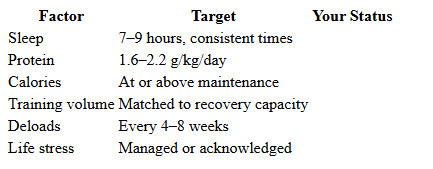
If any of these aren't met, fix them before looking elsewhere.
Sample Recovery-Focused Week
Training: - 4 days of lifting (appropriate volume for you) - 2–3 days of light activity or rest - Deload planned for week 5
Nutrition: - Protein at every meal - Carbs around training - Not in a deficit
Sleep: - 10:30 PM bedtime, 6:30 AM wake (8 hours) - Same times on weekends - Phone away 30 minutes before bed
Stress: - Daily 15-minute walk (not for exercise, for stress) - One hobby or social activity per week - Acknowledgment that work is stressful right now (training adjusted)
Common Mistakes
Prioritizing supplements over sleep. No supplement compensates for 5 hours of sleep. Sleep first.
Training through accumulating fatigue. "Pushing through" chronic fatigue leads to injury and burnout, not gains.
Expecting recovery to be passive. Recovery requires inputs: sleep, food, rest. It's not automatic.
Ignoring life stress. Your body doesn't distinguish between deadlift stress and work stress. Both count.
Using gadgets to fix fundamentals. Massage guns and cold plunges are fine additions, not replacements.
How to Tell It's Working
Within 2–4 weeks of improving recovery: - Energy and motivation improve - Training performance stabilizes or increases - Soreness patterns normalize - Sleep quality improves - Mood improves
Over 8–12 weeks: - Consistent progress in training - Fewer minor injuries or setbacks - Sustainable training rhythm established - General health and well-being improved
Next Steps
Related reads: - Deloads: When You Need Them, How to Do Them, How to Come Back Stronger - Soreness vs Injury vs Overreaching: How to Adjust Without Quitting - How Many Sets Per Muscle Per Week? Volume Landmarks and Recovery Reality
If you want training and recovery aligned with your actual life:
References
Dattilo M, Antunes HK, Medeiros A, et al. Sleep and muscle recovery: endocrinological and molecular basis for a new and promising hypothesis. Med Hypotheses. 2011;77(2):220-222. PubMed
Fullagar HH, Skorski S, Duffield R, Hammes D, Coutts AJ, Meyer T. Sleep and athletic performance: the effects of sleep loss on exercise performance, and physiological and cognitive responses to exercise. Sports Med. 2015;45(2):161-186. PubMed
Kellmann M. Preventing overtraining in athletes in high-intensity sports and stress/recovery monitoring. Scand J Med Sci Sports. 2010;20 Suppl 2:95-102. PubMed
Bishop PA, Jones E, Woods AK. Recovery from training: a brief review. J Strength Cond Res. 2008;22(3):1015-1024. PubMed
Dupuy O, Douzi W, Theurot D, Bosquet L, Dugué B. An Evidence-Based Approach for Choosing Post-exercise Recovery Techniques to Reduce Markers of Muscle Damage, Soreness, Fatigue, and Inflammation: A Systematic Review With Meta-Analysis. Front Physiol. 2018;9:403. PubMed
This is educational content and not medical advice. Consult a qualified clinician for persistent or severe symptoms.