Vegetables and Fruit Every Meal
The Minimum Effective Dose Approach
The Principle
"Eat your vegetables" is the most ignored advice in nutrition. Everyone knows they should. Almost nobody does it consistently.
Here's why it matters for lifters specifically: vegetables and fruit provide fiber, micronutrients, and phytonutrients that support digestion, recovery, immune function, and overall health. You can build muscle without them, but you'll feel and perform better with them.
The goal isn't to become a rabbit. It's to hit a minimum threshold that supports your training and health without making every meal a salad. One serving of vegetables or fruit at every meal is the target. That's it.
What the Research Says
Fiber supports digestion and satiety. Studies show that adequate fiber intake (25–38 g/day) improves gut health, reduces appetite, and supports healthy body composition. Most lifters eating "clean" chicken-and-rice diets are fiber deficient.
Micronutrients support performance. Deficiencies in vitamins and minerals (iron, zinc, magnesium, vitamin D) impair energy production, recovery, and immune function. Vegetables and fruit are dense sources of these nutrients.
Phytonutrients have anti-inflammatory effects. Research shows that compounds in colorful plants (polyphenols, flavonoids) support recovery and reduce inflammation from training.
Fruit doesn't make you fat. Despite myths, studies consistently show that fruit consumption is associated with better body composition, not worse. The fiber and water content make fruit self-limiting.
The Nuance
Quality of the overall diet matters most. If your protein, calories, and training are dialed in, vegetables are the finishing touch. They don't replace the fundamentals. Your body need them.
Some is much better than none. Going from zero vegetables to one serving per meal is a bigger improvement than going from adequate to optimal.
Variety provides broader nutrient coverage. Different colored vegetables provide different micronutrients. Eating the same broccoli every day is fine, but variety is better.
Frozen and canned count. Fresh isn't magically superior. Frozen vegetables are flash-frozen at peak nutrition. Canned (low sodium) works too.
The Plan
The Minimum Effective Dose
Target: 1 serving of vegetables or fruit at every meal
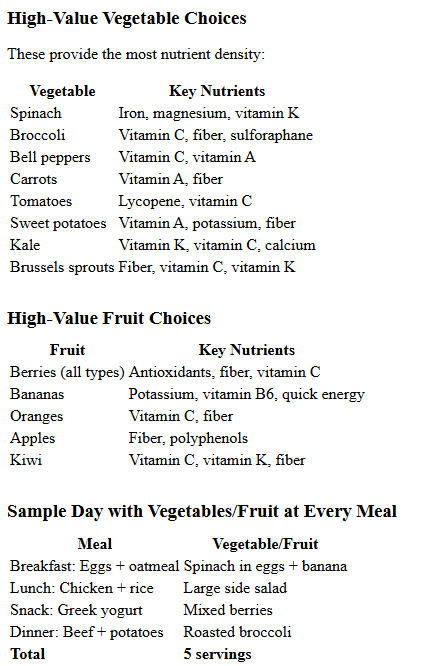
A serving is approximately: - 1 cup raw leafy greens - 1/2 cup cooked vegetables - 1/2 cup raw vegetables - 1 medium piece of fruit - 1/2 cup berries or chopped fruit
If you eat 4 meals per day, that's 4 servings minimum. This is achievable for anyone.
Easy Ways to Add Vegetables
Breakfast: - Spinach or peppers in eggs/omelets - Side of tomatoes or avocado - Handful of greens in a smoothie. It doesn’t have to be a whole thing.
Lunch: - Large side salad - Steamed vegetables with your protein - Raw vegetables (carrots, peppers, cucumber) as a side. The salad can be pre made!
Dinner: - Roasted vegetables (takes 5 minutes to prep) - Steamed broccoli or green beans - Large salad before the main course
Snacks: - Carrots or celery with hummus - Apple or banana - Berries with Greek yogurt
The Lazy Person's Vegetable Strategy
If you hate cooking vegetables:
Buy pre-cut and pre-washed. Bags of pre-cut broccoli, baby carrots, or salad mix. Zero prep required.
Steam in the microwave. Frozen vegetables + microwave = cooked vegetables in 3 minutes.
Roast a big batch. Cut vegetables, toss with oil and salt, roast at 400°F for 25 minutes. Store in the fridge for the week.
Add to existing meals. Throw spinach into whatever you're cooking. It wilts down to nothing and you won't taste it.
Eat raw. Carrots, peppers, cucumbers, and tomatoes require zero cooking.
Easy Fruit Integration
With breakfast: - Banana with oatmeal - Berries in yogurt - Apple on the side
As snacks: - Whole fruit (portable, no prep) - Berries or grapes (easy to grab)
Post-training: - Banana or apple (quick carbs + nutrients) - Fruit in protein smoothie
Common Mistakes
All-or-nothing thinking. "I can't eat 10 servings, so I'll eat zero." One serving is better than none. Start small.
Only eating salads. Salads are fine, but cooked vegetables are often easier to eat in larger quantities. Mix it up.
Avoiding fruit because of sugar. Fruit sugar is packaged with fiber, water, and nutrients. It's not the same as added sugar. Eat fruit.
Relying on supplements. A multivitamin doesn't replace vegetables. The fiber, phytonutrients, and satiety benefits come from whole foods.
Making it complicated. You don't need exotic superfoods. Broccoli, carrots, apples, and bananas are cheap, available, and effective.
How to Tell It's Working
Within 2–4 weeks: - Digestion improves (more regular, less bloating) - Energy more stable throughout the day - Satiety improved (feel fuller on same calories)
Over 8–12 weeks: - Better recovery between sessions - Fewer minor illnesses - Skin, hair, and nails may improve . General sense of feeling healthier. I promise, it’s noticeable.
Next Steps
Related reads: - Whole Foods vs "Clean Eating": How to Eat Like an Adult Without Food Anxiety - Protein for Muscle Gain: How Much You Need, Why, and the Easiest Way to Hit It - Eating Out While Cutting: The 3-Rule System
If you want a sustainable nutrition approach that covers all the fundamentals:
References
Slavin JL, Lloyd B. Health benefits of fruits and vegetables. Adv Nutr. 2012;3(4):506-516. PubMed
Dreher ML. Whole Fruits and Fruit Fiber Emerging Health Effects. Nutrients. 2018;10(12):1833. PubMed
Barber TM, Kabisch S, Pfeiffer AFH, Weickert MO. The Health Benefits of Dietary Fibre. Nutrients. 2020;12(10):3209. PubMed
Liu RH. Health-promoting components of fruits and vegetables in the diet. Adv Nutr. 2013;4(3):384S-392S. PubMed
Boeing H, Bechthold A, Bub A, et al. Critical review: vegetables and fruit in the prevention of chronic diseases. Eur J Nutr. 2012;51(6):637-663. PubMed
This is educational content and not medical advice. Consult a qualified clinician for persistent or severe symptoms.