Protein in a Calorie Deficit:
Preserving Muscle While Losing Fat
The Principle
Losing fat requires a caloric deficit. But a deficit is also a catabolic state, your body is breaking things down to make up the energy gap. Without proper protein intake and resistance training, some of that breakdown can come from the muscle tissue.
You want to lose fat, not muscle, but you’re not sure how. The solution is strategic protein intake. A tad bit higher than you'd need for maintenance combined with continued strength training.
The research is clear: high protein during a deficit is muscle-sparing. The lifters who maintain the most muscle during cuts are the ones eating to their protein goal. Yes, that means having a protein goal.
What the Research Says
Higher protein preserves more lean mass during restriction. A meta-analysis by Helms et al. (2014) on resistance-trained individuals found that protein intakes of 2.3–3.1 g/kg of lean body mass (roughly 1.8–2.4 g/kg of total bodyweight for leaner individuals) supported better lean mass retention during caloric deficits.
Protein needs increase as the deficit increases. The more aggressive your deficit, the higher your protein needs. Moderate deficits can get away with the lower end; steep deficits require the higher end to protect muscle.
Protein is more satiating than carbs or fat. Studies on appetite regulation show that high-protein diets reduce hunger and improve diet adherence. This makes hitting a deficit easier and more sustainable. We want to anchor meals around protein, to use this to our advantage.
Resistance training is non-negotiable. Research shows that protein alone doesn't preserve muscle. it needs the stimulus of resistance training. The combination of high protein plus continued lifting is what protects lean mass. Not just lifting, but challenging yourself as well.
Losing weight too fast increases muscle loss. Studies suggest that rapid weight loss (>1% of bodyweight per week) leads to greater lean mass loss, even with high protein. Slower cuts preserve more muscle. This is just math. To lose weight fast you have to have a big deficit, and with a big deficit you can’t get enough protein for your body to sustain.
The Nuance
Leaner individuals need more protein. If you're already lean (under 15% body fat for men, under 25% for women), muscle loss risk is higher. Aim for the upper end of protein recommendations.
Obese individuals can use lower relative targets. If you have significant fat to lose, protein based on total bodyweight overestimates needs. Use lean body mass or target bodyweight instead.
Protein can take up a larger percentage of calories. Since you're eating fewer total calories, protein will represent a bigger slice of the pie. This is expected and fine.
Deficit duration matters. Short cuts (4–8 weeks) can be more aggressive with less muscle loss. Extended deficits (12+ weeks) should be more moderate to protect lean mass and hormonal health.
The Plan
Protein Targets for Fat Loss
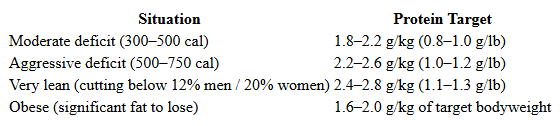
Example calculations:
180 lb lifter, moderate deficit: 180 × 0.9 = 162 g protein/day
160 lb lean lifter, aggressive cut: 160 × 1.1 = 176 g protein/day
250 lb lifter with 200 lb target, moderate deficit: 200 × 0.9 = 180 g protein/day
How to Hit High Protein on Low Calories
When cutting, every calorie counts. You need to maximize protein per calorie.
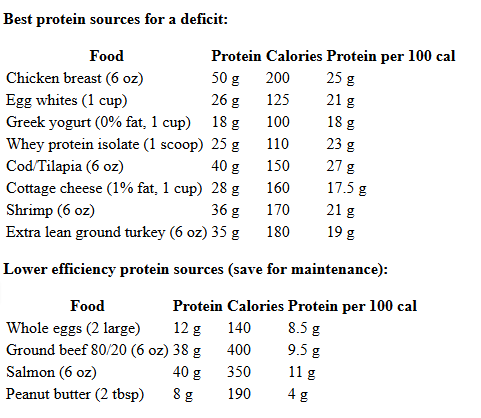
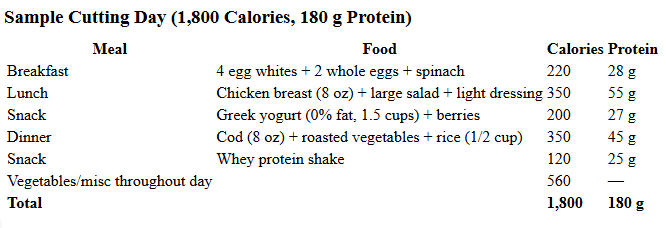
Sample Cutting Day (1,800 Calories, 180 g Protein)
Protein Distribution During a Cut
Spreading protein across meals helps maximize muscle protein synthesis throughout the day:
4+ meals/snacks: 35–50 g protein each
Each meal anchored by protein: Build the meal around the protein source. This is beyond important.
Pre-bed protein: Casein or cottage cheese before sleep may support overnight muscle retention. This especially emphasized because in this scenario we are cutting.
What About Training?
High protein without training won't preserve muscle. During a cut:
Maintain intensity: Keep weights heavy (relative to your current capacity)
Reduce volume if needed: Recovery is compromised; you may need fewer sets
Don't add excessive cardio: Cardio can be useful but shouldn't dominate—it can accelerate muscle loss if overdone
Prioritize compound lifts: Squats, deadlifts, presses, and rows maintain the most muscle
Common Mistakes
Dropping protein when calories drop. This is backwards. Protein should stay the same or increase during a deficit.
Eating fatty protein sources. Whole eggs, bacon, and ribeye are great—but they eat up calories fast during a cut. Lean sources give you more protein per calorie.
Cutting too fast. Aggressive deficits (1000+ calories) lead to more muscle loss, regardless of protein intake. Slower cuts preserve more.
Stopping strength training. Cardio-only cutting destroys muscle. Keep lifting to signal your body to retain lean tissue.
Ignoring satiety. High protein helps control hunger. If you're starving on your cut, you probably need more protein (and possibly a smaller deficit).
How to Tell It's Working
Week to week: - Weight is decreasing at target rate (0.5–1% of bodyweight per week) - Strength is maintained or decreasing minimally - Hunger is manageable (not constant)
Over 8–12 weeks: - Significant fat loss with minimal strength loss - Muscle appearance improves as fat drops - Energy and mood remain reasonable (some drop is expected)
Warning signs: - Strength dropping significantly week over week - Constant hunger and irritability - Losing more than 1% of bodyweight per week consistently - Feeling run down and unable to recover
If these appear, increase calories slightly, ensure protein is sufficient, and consider a diet break.
Next Steps
Related reads: - Slow Deficit Done Right: Lose Fat While Keeping Training Heavy - Protein for Muscle Gain: How Much You Need, Why, and the Easiest Way to Hit It - Eating Out While Cutting: The 3-Rule System
If you want nutrition dialed in for a successful, muscle-preserving cut:
References
Helms ER, Zinn C, Rowlands DS, Brown SR. A systematic review of dietary protein during caloric restriction in resistance trained lean athletes: a case for higher intakes. Int J Sport Nutr Exerc Metab. 2014;24(2):127-138. PubMed
Mettler S, Mitchell N, Tipton KD. Increased protein intake reduces lean body mass loss during weight loss in athletes. Med Sci Sports Exerc. 2010;42(2):326-337. PubMed
Westerterp-Plantenga MS, Lemmens SG, Westerterp KR. Dietary protein - its role in satiety, energetics, weight loss and health. Br J Nutr. 2012;108 Suppl 2:S105-112. PubMed
Longland TM, Oikawa SY, Mitchell CJ, Devries MC, Phillips SM. Higher compared with lower dietary protein during an energy deficit combined with intense exercise promotes greater lean mass gain and fat mass loss: a randomized trial. Am J Clin Nutr. 2016;103(3):738-746. PubMed
Churchward-Venne TA, Murphy CH, Longland TM, Phillips SM. Role of protein and amino acids in promoting lean mass accretion with resistance exercise and attenuating lean mass loss during energy deficit in humans. Amino Acids. 2013;45(2):231-240. PubMed
This is educational content and not medical advice. Consult a qualified clinician for persistent or severe symptoms.