Slow Deficit Done Right:
Lose Fat While Keeping Training Heavy
The Bottom Line
Aggressive cuts lose fat faster but also lose more muscle—slow cuts preserve more of what you've built
Target 0.5–0.75% bodyweight loss per week for most people; go slower if already lean
Protein must stay high (2.0–2.4 g/kg) during a deficit—this is non-negotiable
Maintain training intensity (keep weights heavy); reduce volume if recovery suffers
Diet breaks every 8–12 weeks support hormonal and psychological sustainability
The Principle
Everyone who's ever dieted has made the same mistake: going too hard, too fast. The logic seems sound—bigger deficit means faster fat loss, right?
Technically, yes. But aggressive calorie cuts, excessive cardio, and crash diets produce quick results followed by muscle loss, metabolic adaptation, and eventual regain. The lifters who actually get lean and stay lean don't crash diet. They take their time.
The slow deficit produces steady fat loss while preserving muscle, strength, and sanity. It takes longer, but the results actually stick. The question is whether you're optimizing for the next 8 weeks or the next 8 years.
What the Research Says
Faster weight loss leads to more muscle loss. Research by Garthe et al. (2011) compared fast (0.7% bodyweight loss/week) vs slow (0.7% every two weeks) weight loss in athletes. The slow group lost the same amount of fat but gained muscle, while the fast group lost muscle.
Resistance training preserves lean mass during a deficit. Multiple studies show that continuing to lift heavy during caloric restriction signals the body to retain muscle tissue.
High protein intake is muscle-sparing. Research consistently shows that higher protein intakes (>2.0 g/kg) during a deficit reduce lean mass loss compared to moderate protein intakes.
Metabolic adaptation is real but manageable. Studies show that extended deficits do cause some metabolic slowdown, but this is minimized with adequate protein, resistance training, and diet breaks.
Diet breaks may support long-term success. Research by Byrne et al. (2018) found that intermittent dieting (2 weeks on, 2 weeks at maintenance) produced better fat loss and less metabolic adaptation than continuous dieting.
The Nuance
Your starting point matters. Leaner individuals need smaller deficits to preserve muscle. Those with more fat to lose can handle larger deficits initially.
Training status affects deficit tolerance. Experienced lifters generally lose more muscle with aggressive deficits. Beginners can sometimes build muscle while losing fat even in moderate deficits.
Life stress counts. A 500-calorie deficit during a stressful work period is harder to recover from than the same deficit during a calm phase. Adjust expectations.
Speed depends on timeline. If you have a photoshoot in 8 weeks, you might need a more aggressive approach. If you're just trying to get leaner over the next year, go slow.
The Plan
Deficit Targets by Goal
GoalWeekly Weight LossDeficit SizeVery lean → leaner (sub-12% men, sub-22% women)0.25–0.5% bodyweight200–350 caloriesModerately lean → lean0.5–0.75% bodyweight350–500 caloriesOverweight → leaner0.75–1.0% bodyweight500–750 caloriesSignificant fat loss neededUp to 1% bodyweight750–1000 calories (short term only)
Example for a 200 lb moderately lean lifter: - Target: 0.5–0.75% per week = 1.0–1.5 lbs/week - Deficit: 350–500 calories below maintenance
Setting Up Your Deficit
Step 1: Find Your Maintenance Calories
Use one of these methods: - Track for 2 weeks: Eat normally, track everything, see what maintains your weight. Through the two weeks, if you’re up over that time. You know you need to cut back to be at true maintenance. - Formula estimate: Bodyweight (lbs) × 14–16 (lower if sedentary, higher if active) - Start with an estimate and adjust: Begin at bodyweight × 15 and adjust based on results. Easy option? Just google your height, weight, and gender to get an idea.
Step 2: Create the Deficit
Subtract 300–500 calories from maintenance. This is your starting target.
Step 3: Set Protein
Protein should be 2.0–2.4 g/kg (0.9–1.1 g/lb) during a deficit. This is non-negotiable.
Step 4: Fill Remaining Calories with Carbs and Fat
After protein is set: - Keep fat at minimum healthy level: ~0.5 g/kg (0.25 g/lb) - Fill the rest with carbs to fuel training
Example for 200 lb lifter on 2,200 calories (500 deficit): - Protein: 200 g = 800 calories - Fat: 55 g = 495 calories - Carbs: remaining 905 calories = 226 g
The Slow Cut Framework
Phase 1: Initial Deficit (Weeks 1–4)
Set deficit at target level
Track weight daily, average weekly
Expect some initial water loss (don't get excited—it's not all fat)
Adjust nothing unless weight is static for 2+ weeks
Phase 2: Adjustment Phase (Weeks 5–12)
If weight loss stalls for 2 weeks, reduce calories by 100–150 or add light cardio
Strength may plateau; maintain current weights, don't expect PRs
Fatigue may increase; adjust training volume if needed (keep intensity)
Phase 3: Diet Break (Every 8–12 Weeks)
Return to maintenance calories for 1–2 weeks
Maintain protein and training
Allows hormonal and psychological recovery
Resume deficit after the break
Phase 4: Transition to Maintenance
When goal weight/leanness is reached, don't immediately return to pre-diet eating
Reverse diet: add 100–150 calories per week back to maintenance
This minimizes rebound weight gain
Training During a Deficit
Priority 1: Maintain intensity (weight on the bar) - Keep weights as heavy as possible - If you were squatting 225 × 8, aim to maintain 225 × 8 (or 225 × 7) - Don't preemptively drop weight
Priority 2: Reduce volume if needed - Recovery is compromised in a deficit - Dropping 20–30% of volume is acceptable - Keep the most important sets (first 2–3 sets per exercise)
Priority 3: Limit cardio - Cardio can help create deficit but has diminishing returns - 2–4 sessions of Zone 2 cardio (20–30 min) is usually sufficient - Excessive cardio accelerates muscle loss
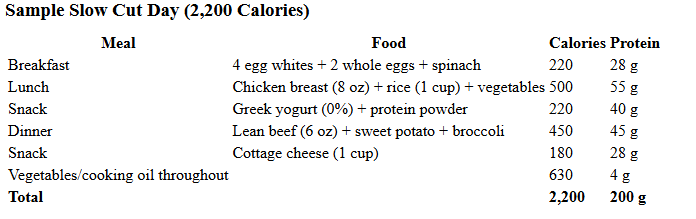
Sample Slow Cut Day (2,200 Calories)
Common Mistakes
Going too aggressive. A 1,000-calorie deficit produces fast weight loss but significant muscle loss. Slow down.
Dropping weight too fast on lifts. Don't preemptively lighten loads. Let performance dictate adjustments.
Excessive cardio. Using cardio to create a 500+ calorie deficit daily is unsustainable and muscle-wasting.
No diet breaks. Extended continuous deficits lead to metabolic adaptation and diet fatigue. Take breaks.
Returning to old eating immediately. After a cut, reverse diet slowly. Jumping back to maintenance causes rapid water and fat regain.
How to Tell It's Working
Weekly indicators: - Weight trending down at target rate (weekly average) - Strength maintained or minimally decreased - Energy manageable (not great, but not debilitating) - Hunger present but not overwhelming
Over 8–12 weeks: - Clear visual changes in body composition - Clothes fitting differently - Strength mostly maintained - No significant injury or illness
Warning signs: - Losing more than 1% bodyweight per week consistently - Strength dropping significantly week over week - Constant hunger, irritability, poor sleep - Getting sick frequently - Losing motivation to train
If warning signs appear, eat at maintenance for 1–2 weeks, then resume with a smaller deficit.
Next Steps
If you want a sustainable cut that preserves your hard-earned muscle:
References
Garthe I, Raastad T, Refsnes PE, Koivisto A, Sundgot-Borgen J. Effect of two different weight-loss rates on body composition and strength and power-related performance in elite athletes. Int J Sport Nutr Exerc Metab. 2011;21(2):97-104. PubMed
Byrne NM, Sainsbury A, King NA, Hills AP, Wood RE. Intermittent energy restriction improves weight loss efficiency in obese men: the MATADOR study. Int J Obes. 2018;42(2):129-138. PubMed
Trexler ET, Smith-Ryan AE, Norton LE. Metabolic adaptation to weight loss: implications for the athlete. J Int Soc Sports Nutr. 2014;11(1):7. PubMed
Helms ER, Aragon AA, Fitschen PJ. Evidence-based recommendations for natural bodybuilding contest preparation: nutrition and supplementation. J Int Soc Sports Nutr. 2014;11:20. PubMed
Murphy CH, Hector AJ, Phillips SM. Considerations for protein intake in managing weight loss in athletes. Eur J Sport Sci. 2015;15(1):21-28. PubMed
This is educational content and not medical advice. Consult a qualified clinician for persistent or severe symptoms.