Move Well, Then Push
Training philosophy checklist
The Bottom Line
Technique is the foundation. We develop the confidence to go heavy by proving you can do it well.
Strength work should feel heavy; that's the point. Heavy doesn't mean sloppy or reckless.
Taking care of your body (sleep, food, mobility) is not optional. These are what allow you to push hard sustainably.
The lifters who are strong didn’t develop that strength over night. It takes time and patience, they're the ones who trained smartly across their entire lives.
The Principle
There are two ways to destroy your training career.
The first is to obsess over "perfect" form, never challenge yourself, and spin your wheels for years making no progress. The second is to chase numbers recklessly, ignore pain signals, accumulate injuries, and eventually break down.
"Move well, then push" is the alternative to both. It means technique comes before intensity, long-term progress trumps short-term PRs, and taking care of your body isn’t something we do later, not because we're soft, but because it's what actually works.
The goal is both: move well AND push hard. In that order. Master the movement, then load it aggressively. Earn the right to go heavy by proving you can do it well.
What the Research Says
Technique affects injury risk. Biomechanical research shows that deviations from optimal movement patterns—like excessive spinal flexion during deadlifts or knee valgus during squats—increase stress on vulnerable structures.
Strength is skill. Motor learning research demonstrates that movement quality improves with deliberate practice. The lifters who focus on technique early develop better movement patterns that persist under heavy loads.
Consistency beats intensity. Studies on long-term training outcomes show that sustainable, progressive training produces better results than cycles of aggressive pushing followed by injury and time off.
Proper loading drives adaptation. Research also shows that submaximal training without sufficient intensity fails to produce strength or hypertrophy gains. You have to push—the question is how and when.
The Nuance
"Move well" doesn't mean perfect. No one has textbook form on every rep. The goal is great technique with positions that load the target muscles optimally, and functionally align with the programs goals.
"Push" doesn't mean reckless. Pushing hard means training close to failure, progressively overloading, and challenging yourself. It doesn't mean grinding reps with dangerous form, weeks on end.
The order matters. If you can't do a movement well with light weight, you shouldn't do it with heavy weight. But once you CAN do it well, you should push it.
This is a long game. Time, effort, consistency. Sustainable progress beats unsustainable intensity.
The Plan
The "Move Well, Then Push" Checklist
Step 1: Can You Do It Pain-Free?
If a movement causes pain (not discomfort, but actual pain): - Modify the movement (range of motion, grip, stance) - Substitute a similar movement that doesn't hurt - Address the underlying issue if persistent. Pain is the body telling us something. Don't push through it hoping it will go away, it’s ideal to assess and correct.
Step 2: Can You Control the Movement?
Before loading heavily, you should be able to: Demonstrate the full range of motion with bodyweight & light load - Control the eccentric (lowering) without collapsing - Pause at challenging positions without losing position - Repeat the movement with consistent technique. If you can't control it light, you can't control it heavy.
Step 3: Can You Maintain Position Under Fatigue?
Technique often breaks down when tired. Check: Does your form change significantly from rep 1 to rep 8? - Do you lose position on the last few reps of a hard set? - Can you maintain technique when intensity reaches 8-9? If fatigue destroys your form, reduce load or reps until you can maintain quality.
Step 4: Now Push
Once steps 1–3 are done: - Load the movement progressively and moderately. - Train at appropriate intensity (RPE 7–9 for most working sets) - Push toward failure when appropriate - Pursue PRs with confidence
Earn the right to push by demonstrating competence first.
The Depth.RX Training Principles
Principle 1: Technique is the foundation
Every movement has a technique standard. Learn it, practice it, maintain it. Technique isn't a phase you outgrow—it's a skill you maintain forever.
Principle 2: Strength work should feel heavy
If you're training for strength, heavy weights should feel heavy. That's the point. Don't expect 90% of your max to feel light. Embrace the challenge.
Principle 3: It's good to do hard things
Training should be challenging. Comfort doesn't produce adaptation. Push yourself—not recklessly, but deliberately. Growth happens outside your comfort zone.
Principle 4: Taking care of your body is not optional
Sleep, nutrition, mobility, and recovery are part of training, not obstacles to it. You can't out-train poor recovery. Take care of the machine.
Principle 5: Progress is the goal, not punishment
Training is not penance. It's investment. Every session should move you closer to your goals. If you're always beat up, injured, or dreading the gym, something is wrong.
Practical Applications
Application 1: The Technique Threshold
For every major lift, establish a "technique threshold" the load at which your form starts to break down. Train below this threshold for most of your volume. Occasionally test above it to push capacity, but don't live there.
Application 2: The RPE Ceiling
Most working sets should be RPE 7–9. RPE 10 (true failure) is reserved for specific situations—testing, final sets, or strategic overreaching. Constantly grinding at RPE 10 is unsustainable.
Application 3: The Modification Mindset
If a movement doesn't work for your body, modify it without ego. Trap bar instead of conventional deadlift. Neutral grip instead of pronated. Floor press instead of full bench. The best exercise is the one you can do well and progressively load.
Application 4: The Long-Term Lens
Before every training decision, ask: "Is this sustainable for 10 years?" If the answer is no, reconsider. Training should build you up over decades, not break you down over months.
The Move Well, Then Push Decision Tree
Can you do this movement pain-free?
│
├─ No → Modify or substitute
│
└─ Yes → Can you control it with light load?
          │
          ├─ No → Practice technique before loading
          │
          └─ Yes → Can you maintain form under fatigue?
                    │
                    ├─ No → Build capacity at moderate loads
                    │
                    └─ Yes → PUSH (progressive overload, high RPE)
Common Mistakes
All technique, no intensity. Perfectionists who never push because they're waiting for perfect form. Perfect doesn't exist. Good enough is good enough—then push.
All intensity, no technique. Ego lifters who chase numbers with terrible form. This works until it doesn't—then comes injury and regression.
Ignoring pain signals. Pain is information. Ignoring it leads to worse pain. Respect the signal.
Thinking mobility work replaces training. Mobility is preparation, not the main event. Don't spend an hour stretching and 20 minutes lifting.
Short-term thinking. Training through minor injuries, skipping recovery, maxing out weekly. This might work for a few months. It fails over years.
How to Tell It's Working
Short-term indicators: - Training sessions feel productive, not destructive - Technique is consistent across sets - Progress is happening (weight, reps, or quality) - No accumulating injuries or persistent pain
Long-term indicators: - Continuous progress over months and years - Ability to train consistently without major setbacks - Movement quality improves over time - Enjoying training, not dreading it
Red flags: - Frequent minor injuries or tweaks - Technique degrading over time - Dreading training sessions - Frequent forced deloads or time off
Next Steps
Related reads: - Hypertrophy vs Strength: What Changes (and What Doesn't) in Your Training Plan - Progressive Overload That Actually Works: Beyond "Add Weight Every Week" - Deloads: When You Need Them, How to Do Them, How to Come Back Stronger
If you want coaching built on sustainable, long-term principles:
References
Schoenfeld BJ. The mechanisms of muscle hypertrophy and their application to resistance training. J Strength Cond Res. 2010;24(10):2857-2872. PubMed
Suchomel TJ, Nimphius S, Stone MH. The Importance of Muscular Strength in Athletic Performance. Sports Med. 2016;46(10):1419-1449. PubMed
McGill SM. Low Back Disorders: Evidence-Based Prevention and Rehabilitation. 3rd ed. Human Kinetics; 2015.
Kiely J. Periodization paradigms in the 21st century: evidence-led or tradition-driven? Int J Sports Physiol Perform. 2012;7(3):242-250. PubMed
Impellizzeri FM, Marcora SM, Coutts AJ. Internal and External Training Load: 15 Years On. Int J Sports Physiol Perform. 2019;14(2):270-273. PubMed
This is educational content and not medical advice. Consult a qualified clinician for persistent or severe symptoms.
Recovery Basics for Lifters
What Actually Moves the Needle (Sleep, Stress, Food, Load)
The Bottom Line
Sleep is irreplaceable. no supplement or gadget substitutes for 7-9 hours
Nutrition (especially protein and total calories) provides the building blocks for recovery. THIS IS BIOLOGY AND NOT DEBATABLE.
Life stress and training stress draw from the same pool, YOU. There’s no ignoring that.
Foam rolling, massage, and cold plunges are help, sure. The fundamentals are non-negotiable, and what need focus.
If you're not recovering well, fix sleep and food before changing your program
The Principle
Most lifters obsess over training variables. Sets, reps, exercises, and largely ignore recovery variables. This is backwards, the efforts there just in the wrong place.
Recovery is when adaptation actually happens. Training creates stimulus; recovery creates results. You don't get stronger in the gym. You get stronger when you rest, eat, and sleep after the gym.
Perfect training with poor recovery produces mediocre results. Good training with excellent recovery produces excellent results. The fundamentals, sleep, food, and managing training load, account for 90% of recovery. Everything else is marginal gains.
What the Research Says
Sleep deprivation impairs recovery and performance. Studies show that insufficient sleep reduces muscle protein synthesis, increases cortisol, decreases testosterone, impairs glucose metabolism, and reduces next-day performance. Sleep is the single most important recovery factor. You’re literally getting a debuff for missing out on your sleep.
Nutrition affects recovery capacity. Research shows that adequate protein and calories support muscle repair and glycogen replenishment. Undereating impairs recovery, particularly protein deficiency.
Stress is additive. Research on the stress-recovery model shows that training stress and life stress draw from the same pool. High life stress reduces your capacity to recover from training stress.
Training load management matters. Studies on periodization show that planned deloads and intelligent volume management prevent overreaching and support long-term progress.
Most "recovery modalities" have minimal impact. Research on foam rolling, massage, compression, ice baths, and similar interventions shows small or inconsistent effects compared to the fundamentals.
The Nuance
Recovery needs are individual. Some people recover quickly; others need more time. Age, training history, genetics, and life circumstances all affect recovery capacity.
Recovery isn't linear. Some weeks you'll feel great; others you'll feel run down despite doing everything right. This is normal.
More recovery isn't always better. Taking a week off when you feel fine won't accelerate progress. Recovery strategies should match your actual fatigue level.
The Plan
The Recovery Hierarchy
Tier 1: Sleep (Most Important)
Sleep is irreplaceable.
No supplement, gadget, or protocol substitutes for adequate sleep.
Targets: - 7–9 hours per night for adults - Consistent bed and wake times (±30 minutes) - Sleep quality matters as much as duration
Sleep improvement strategies: - Same bedtime and wake time daily (including weekends)
- Cool, dark room (65–68°F)
- No screens 30–60 minutes before bed
- Limit caffeine after early afternoon
- Avoid heavy meals 2–3 hours before bed
- If you can't sleep, get up; don't lie there stressing
Tier 2: Nutrition
You can't recover without building materials. Protein, carbs, and total calories provide them. THIS IS BIOLOGY, AND NOT UP FOR DEBATE.
Targets: - Protein: 1.6–2.2 g/kg bodyweight daily
- Carbs: Sufficient to fuel training (varies by volume)
- Calories: At or above maintenance for optimal recovery
Nutrition for recovery: - Distribute protein across 3–5 meals - Eat carbs around training for fuel and replenishment - Don't starve yourself after training - Stay hydrated.
Tier 3: Training Load Management
Your training itself affects your recovery needs. More training = more recovery required. So if you train a lot, and don’t recover a lot. Reflect how we can execute and improve.
Strategies: - Match training volume to recovery capacity (Meaning train as hard as you can up to the point you can’t recover from it)
- Include planned deloads every 6-8 weeks - Reduce volume during high-stress life periods - Don't increase volume and intensity simultaneously. These variables ebb and flow.
Tier 4: Stress Management
Chronic life stress impairs recovery from training. You can't separate them.
Strategies: - Identify major stressors (work, relationships, finances) - Build stress-reducing habits (walks, hobbies, social connection) - Accept that some periods require lighter training - Don't add training stress when life stress is high
Tier 5: Everything Else (Marginal)
Foam rolling, massage, ice baths, compression, and similar interventions may help at the margins but don't replace the fundamentals.
When to use: - If you've optimized Tiers 1- 4 and want slight additional edge - If you subjectively feel better using them - If they help you mentally transition out of training mode
Don't rely on: - Foam rolling to fix poor sleep - Supplements to fix poor nutrition - Gadgets to fix excessive training volume
How to Assess Your Recovery
You're recovering well if: - Sleep is restful, wake feeling refreshed - Motivation to train is present - Performance is stable or improving - Soreness resolves within 48–72 hours - Mood and energy are stable - No accumulating aches or pains
You're NOT recovering well if: - Sleep is disrupted or not refreshing - Motivation to train is chronically low - Performance is declining - Soreness persists beyond 72 hours - Mood is low, irritable, anxious - Nagging pains or injuries accumulating - Getting sick frequently
Quick Recovery Checklist
Before blaming your program or buying supplements, check these:
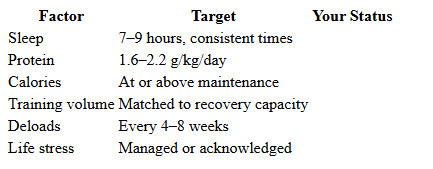
If any of these aren't met, fix them before looking elsewhere.
Sample Recovery-Focused Week
Training: - 4 days of lifting (appropriate volume for you) - 2–3 days of light activity or rest - Deload planned for week 5
Nutrition: - Protein at every meal - Carbs around training - Not in a deficit
Sleep: - 10:30 PM bedtime, 6:30 AM wake (8 hours) - Same times on weekends - Phone away 30 minutes before bed
Stress: - Daily 15-minute walk (not for exercise, for stress) - One hobby or social activity per week - Acknowledgment that work is stressful right now (training adjusted)
Common Mistakes
Prioritizing supplements over sleep. No supplement compensates for 5 hours of sleep. Sleep first.
Training through accumulating fatigue. "Pushing through" chronic fatigue leads to injury and burnout, not gains.
Expecting recovery to be passive. Recovery requires inputs: sleep, food, rest. It's not automatic.
Ignoring life stress. Your body doesn't distinguish between deadlift stress and work stress. Both count.
Using gadgets to fix fundamentals. Massage guns and cold plunges are fine additions, not replacements.
How to Tell It's Working
Within 2–4 weeks of improving recovery: - Energy and motivation improve - Training performance stabilizes or increases - Soreness patterns normalize - Sleep quality improves - Mood improves
Over 8–12 weeks: - Consistent progress in training - Fewer minor injuries or setbacks - Sustainable training rhythm established - General health and well-being improved
Next Steps
Related reads: - Deloads: When You Need Them, How to Do Them, How to Come Back Stronger - Soreness vs Injury vs Overreaching: How to Adjust Without Quitting - How Many Sets Per Muscle Per Week? Volume Landmarks and Recovery Reality
If you want training and recovery aligned with your actual life:
References
Dattilo M, Antunes HK, Medeiros A, et al. Sleep and muscle recovery: endocrinological and molecular basis for a new and promising hypothesis. Med Hypotheses. 2011;77(2):220-222. PubMed
Fullagar HH, Skorski S, Duffield R, Hammes D, Coutts AJ, Meyer T. Sleep and athletic performance: the effects of sleep loss on exercise performance, and physiological and cognitive responses to exercise. Sports Med. 2015;45(2):161-186. PubMed
Kellmann M. Preventing overtraining in athletes in high-intensity sports and stress/recovery monitoring. Scand J Med Sci Sports. 2010;20 Suppl 2:95-102. PubMed
Bishop PA, Jones E, Woods AK. Recovery from training: a brief review. J Strength Cond Res. 2008;22(3):1015-1024. PubMed
Dupuy O, Douzi W, Theurot D, Bosquet L, Dugué B. An Evidence-Based Approach for Choosing Post-exercise Recovery Techniques to Reduce Markers of Muscle Damage, Soreness, Fatigue, and Inflammation: A Systematic Review With Meta-Analysis. Front Physiol. 2018;9:403. PubMed
This is educational content and not medical advice. Consult a qualified clinician for persistent or severe symptoms.
Vegetables and Fruit Every Meal
The Minimum Effective Dose Approach
The Principle
"Eat your vegetables" is the most ignored advice in nutrition. Everyone knows they should. Almost nobody does it consistently.
Here's why it matters for lifters specifically: vegetables and fruit provide fiber, micronutrients, and phytonutrients that support digestion, recovery, immune function, and overall health. You can build muscle without them, but you'll feel and perform better with them.
The goal isn't to become a rabbit. It's to hit a minimum threshold that supports your training and health without making every meal a salad. One serving of vegetables or fruit at every meal is the target. That's it.
What the Research Says
Fiber supports digestion and satiety. Studies show that adequate fiber intake (25–38 g/day) improves gut health, reduces appetite, and supports healthy body composition. Most lifters eating "clean" chicken-and-rice diets are fiber deficient.
Micronutrients support performance. Deficiencies in vitamins and minerals (iron, zinc, magnesium, vitamin D) impair energy production, recovery, and immune function. Vegetables and fruit are dense sources of these nutrients.
Phytonutrients have anti-inflammatory effects. Research shows that compounds in colorful plants (polyphenols, flavonoids) support recovery and reduce inflammation from training.
Fruit doesn't make you fat. Despite myths, studies consistently show that fruit consumption is associated with better body composition, not worse. The fiber and water content make fruit self-limiting.
The Nuance
Quality of the overall diet matters most. If your protein, calories, and training are dialed in, vegetables are the finishing touch. They don't replace the fundamentals. Your body need them.
Some is much better than none. Going from zero vegetables to one serving per meal is a bigger improvement than going from adequate to optimal.
Variety provides broader nutrient coverage. Different colored vegetables provide different micronutrients. Eating the same broccoli every day is fine, but variety is better.
Frozen and canned count. Fresh isn't magically superior. Frozen vegetables are flash-frozen at peak nutrition. Canned (low sodium) works too.
The Plan
The Minimum Effective Dose
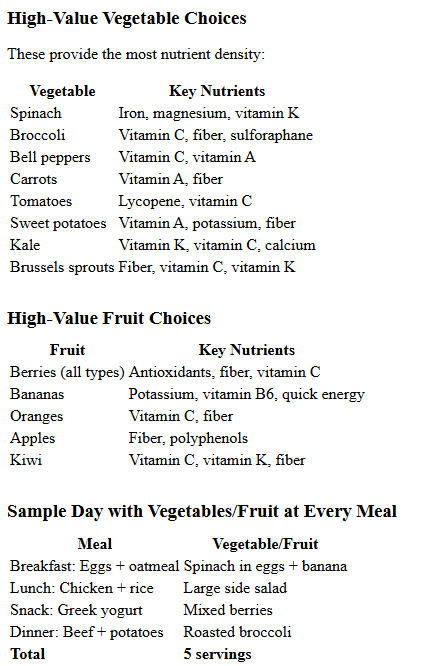
Target: 1 serving of vegetables or fruit at every meal
A serving is approximately: - 1 cup raw leafy greens - 1/2 cup cooked vegetables - 1/2 cup raw vegetables - 1 medium piece of fruit - 1/2 cup berries or chopped fruit
If you eat 4 meals per day, that's 4 servings minimum. This is achievable for anyone.
Easy Ways to Add Vegetables
Breakfast: - Spinach or peppers in eggs/omelets - Side of tomatoes or avocado - Handful of greens in a smoothie. It doesn’t have to be a whole thing.
Lunch: - Large side salad - Steamed vegetables with your protein - Raw vegetables (carrots, peppers, cucumber) as a side. The salad can be pre made!
Dinner: - Roasted vegetables (takes 5 minutes to prep) - Steamed broccoli or green beans - Large salad before the main course
Snacks: - Carrots or celery with hummus - Apple or banana - Berries with Greek yogurt
The Lazy Person's Vegetable Strategy
If you hate cooking vegetables:
Buy pre-cut and pre-washed. Bags of pre-cut broccoli, baby carrots, or salad mix. Zero prep required.
Steam in the microwave. Frozen vegetables + microwave = cooked vegetables in 3 minutes.
Roast a big batch. Cut vegetables, toss with oil and salt, roast at 400°F for 25 minutes. Store in the fridge for the week.
Add to existing meals. Throw spinach into whatever you're cooking. It wilts down to nothing and you won't taste it.
Eat raw. Carrots, peppers, cucumbers, and tomatoes require zero cooking.
Easy Fruit Integration
With breakfast: - Banana with oatmeal - Berries in yogurt - Apple on the side
As snacks: - Whole fruit (portable, no prep) - Berries or grapes (easy to grab)
Post-training: - Banana or apple (quick carbs + nutrients) - Fruit in protein smoothie
Common Mistakes
All-or-nothing thinking. "I can't eat 10 servings, so I'll eat zero." One serving is better than none. Start small.
Only eating salads. Salads are fine, but cooked vegetables are often easier to eat in larger quantities. Mix it up.
Avoiding fruit because of sugar. Fruit sugar is packaged with fiber, water, and nutrients. It's not the same as added sugar. Eat fruit.
Relying on supplements. A multivitamin doesn't replace vegetables. The fiber, phytonutrients, and satiety benefits come from whole foods.
Making it complicated. You don't need exotic superfoods. Broccoli, carrots, apples, and bananas are cheap, available, and effective.
How to Tell It's Working
Within 2–4 weeks: - Digestion improves (more regular, less bloating) - Energy more stable throughout the day - Satiety improved (feel fuller on same calories)
Over 8–12 weeks: - Better recovery between sessions - Fewer minor illnesses - Skin, hair, and nails may improve . General sense of feeling healthier. I promise, it’s noticeable.
Next Steps
Related reads: - Whole Foods vs "Clean Eating": How to Eat Like an Adult Without Food Anxiety - Protein for Muscle Gain: How Much You Need, Why, and the Easiest Way to Hit It - Eating Out While Cutting: The 3-Rule System
If you want a sustainable nutrition approach that covers all the fundamentals:
References
Slavin JL, Lloyd B. Health benefits of fruits and vegetables. Adv Nutr. 2012;3(4):506-516. PubMed
Dreher ML. Whole Fruits and Fruit Fiber Emerging Health Effects. Nutrients. 2018;10(12):1833. PubMed
Barber TM, Kabisch S, Pfeiffer AFH, Weickert MO. The Health Benefits of Dietary Fibre. Nutrients. 2020;12(10):3209. PubMed
Liu RH. Health-promoting components of fruits and vegetables in the diet. Adv Nutr. 2013;4(3):384S-392S. PubMed
Boeing H, Bechthold A, Bub A, et al. Critical review: vegetables and fruit in the prevention of chronic diseases. Eur J Nutr. 2012;51(6):637-663. PubMed
This is educational content and not medical advice. Consult a qualified clinician for persistent or severe symptoms.
Protein in a Calorie Deficit:
Preserving Muscle While Losing Fat
The Principle
Losing fat requires a caloric deficit. But a deficit is also a catabolic state, your body is breaking things down to make up the energy gap. Without proper protein intake and resistance training, some of that breakdown can come from the muscle tissue.
You want to lose fat, not muscle, but you’re not sure how. The solution is strategic protein intake. A tad bit higher than you'd need for maintenance combined with continued strength training.
The research is clear: high protein during a deficit is muscle-sparing. The lifters who maintain the most muscle during cuts are the ones eating to their protein goal. Yes, that means having a protein goal.
What the Research Says
Higher protein preserves more lean mass during restriction. A meta-analysis by Helms et al. (2014) on resistance-trained individuals found that protein intakes of 2.3–3.1 g/kg of lean body mass (roughly 1.8–2.4 g/kg of total bodyweight for leaner individuals) supported better lean mass retention during caloric deficits.
Protein needs increase as the deficit increases. The more aggressive your deficit, the higher your protein needs. Moderate deficits can get away with the lower end; steep deficits require the higher end to protect muscle.
Protein is more satiating than carbs or fat. Studies on appetite regulation show that high-protein diets reduce hunger and improve diet adherence. This makes hitting a deficit easier and more sustainable. We want to anchor meals around protein, to use this to our advantage.
Resistance training is non-negotiable. Research shows that protein alone doesn't preserve muscle. it needs the stimulus of resistance training. The combination of high protein plus continued lifting is what protects lean mass. Not just lifting, but challenging yourself as well.
Losing weight too fast increases muscle loss. Studies suggest that rapid weight loss (>1% of bodyweight per week) leads to greater lean mass loss, even with high protein. Slower cuts preserve more muscle. This is just math. To lose weight fast you have to have a big deficit, and with a big deficit you can’t get enough protein for your body to sustain.
The Nuance
Leaner individuals need more protein. If you're already lean (under 15% body fat for men, under 25% for women), muscle loss risk is higher. Aim for the upper end of protein recommendations.
Obese individuals can use lower relative targets. If you have significant fat to lose, protein based on total bodyweight overestimates needs. Use lean body mass or target bodyweight instead.
Protein can take up a larger percentage of calories. Since you're eating fewer total calories, protein will represent a bigger slice of the pie. This is expected and fine.
Deficit duration matters. Short cuts (4–8 weeks) can be more aggressive with less muscle loss. Extended deficits (12+ weeks) should be more moderate to protect lean mass and hormonal health.
The Plan
Protein Targets for Fat Loss
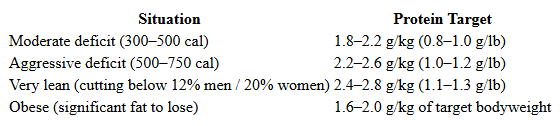
Example calculations:
180 lb lifter, moderate deficit: 180 × 0.9 = 162 g protein/day
160 lb lean lifter, aggressive cut: 160 × 1.1 = 176 g protein/day
250 lb lifter with 200 lb target, moderate deficit: 200 × 0.9 = 180 g protein/day
How to Hit High Protein on Low Calories
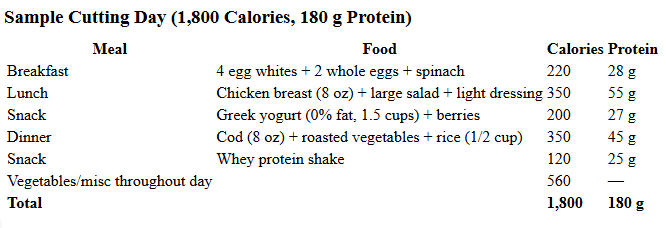
When cutting, every calorie counts. You need to maximize protein per calorie.
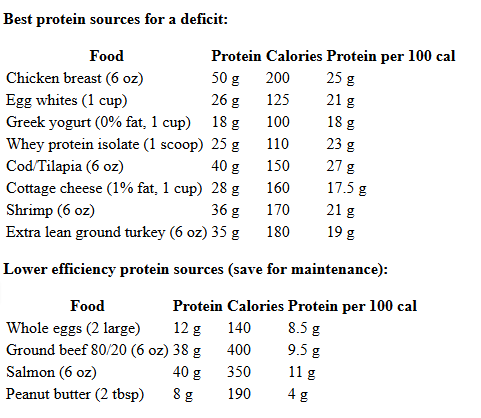
Sample Cutting Day (1,800 Calories, 180 g Protein)
Protein Distribution During a Cut
Spreading protein across meals helps maximize muscle protein synthesis throughout the day:
4+ meals/snacks: 35–50 g protein each
Each meal anchored by protein: Build the meal around the protein source. This is beyond important.
Pre-bed protein: Casein or cottage cheese before sleep may support overnight muscle retention. This especially emphasized because in this scenario we are cutting.
What About Training?
High protein without training won't preserve muscle. During a cut:
Maintain intensity: Keep weights heavy (relative to your current capacity)
Reduce volume if needed: Recovery is compromised; you may need fewer sets
Don't add excessive cardio: Cardio can be useful but shouldn't dominate—it can accelerate muscle loss if overdone
Prioritize compound lifts: Squats, deadlifts, presses, and rows maintain the most muscle
Common Mistakes
Dropping protein when calories drop. This is backwards. Protein should stay the same or increase during a deficit.
Eating fatty protein sources. Whole eggs, bacon, and ribeye are great—but they eat up calories fast during a cut. Lean sources give you more protein per calorie.
Cutting too fast. Aggressive deficits (1000+ calories) lead to more muscle loss, regardless of protein intake. Slower cuts preserve more.
Stopping strength training. Cardio-only cutting destroys muscle. Keep lifting to signal your body to retain lean tissue.
Ignoring satiety. High protein helps control hunger. If you're starving on your cut, you probably need more protein (and possibly a smaller deficit).
How to Tell It's Working
Week to week: - Weight is decreasing at target rate (0.5–1% of bodyweight per week) - Strength is maintained or decreasing minimally - Hunger is manageable (not constant)
Over 8–12 weeks: - Significant fat loss with minimal strength loss - Muscle appearance improves as fat drops - Energy and mood remain reasonable (some drop is expected)
Warning signs: - Strength dropping significantly week over week - Constant hunger and irritability - Losing more than 1% of bodyweight per week consistently - Feeling run down and unable to recover
If these appear, increase calories slightly, ensure protein is sufficient, and consider a diet break.
Next Steps
Related reads: - Slow Deficit Done Right: Lose Fat While Keeping Training Heavy - Protein for Muscle Gain: How Much You Need, Why, and the Easiest Way to Hit It - Eating Out While Cutting: The 3-Rule System
If you want nutrition dialed in for a successful, muscle-preserving cut:
References
Helms ER, Zinn C, Rowlands DS, Brown SR. A systematic review of dietary protein during caloric restriction in resistance trained lean athletes: a case for higher intakes. Int J Sport Nutr Exerc Metab. 2014;24(2):127-138. PubMed
Mettler S, Mitchell N, Tipton KD. Increased protein intake reduces lean body mass loss during weight loss in athletes. Med Sci Sports Exerc. 2010;42(2):326-337. PubMed
Westerterp-Plantenga MS, Lemmens SG, Westerterp KR. Dietary protein - its role in satiety, energetics, weight loss and health. Br J Nutr. 2012;108 Suppl 2:S105-112. PubMed
Longland TM, Oikawa SY, Mitchell CJ, Devries MC, Phillips SM. Higher compared with lower dietary protein during an energy deficit combined with intense exercise promotes greater lean mass gain and fat mass loss: a randomized trial. Am J Clin Nutr. 2016;103(3):738-746. PubMed
Churchward-Venne TA, Murphy CH, Longland TM, Phillips SM. Role of protein and amino acids in promoting lean mass accretion with resistance exercise and attenuating lean mass loss during energy deficit in humans. Amino Acids. 2013;45(2):231-240. PubMed
This is educational content and not medical advice. Consult a qualified clinician for persistent or severe symptoms.
Slow Deficit Done Right:
Lose Fat While Keeping Training Heavy
The Bottom Line
Aggressive cuts lose fat faster but also lose more muscle—slow cuts preserve more of what you've built
Target 0.5–0.75% bodyweight loss per week for most people; go slower if already lean
Protein must stay high (2.0–2.4 g/kg) during a deficit—this is non-negotiable
Maintain training intensity (keep weights heavy); reduce volume if recovery suffers
Diet breaks every 8–12 weeks support hormonal and psychological sustainability
The Principle
Everyone who's ever dieted has made the same mistake: going too hard, too fast. The logic seems sound—bigger deficit means faster fat loss, right?
Technically, yes. But aggressive calorie cuts, excessive cardio, and crash diets produce quick results followed by muscle loss, metabolic adaptation, and eventual regain. The lifters who actually get lean and stay lean don't crash diet. They take their time.
The slow deficit produces steady fat loss while preserving muscle, strength, and sanity. It takes longer, but the results actually stick. The question is whether you're optimizing for the next 8 weeks or the next 8 years.
What the Research Says
Faster weight loss leads to more muscle loss. Research by Garthe et al. (2011) compared fast (0.7% bodyweight loss/week) vs slow (0.7% every two weeks) weight loss in athletes. The slow group lost the same amount of fat but gained muscle, while the fast group lost muscle.
Resistance training preserves lean mass during a deficit. Multiple studies show that continuing to lift heavy during caloric restriction signals the body to retain muscle tissue.
High protein intake is muscle-sparing. Research consistently shows that higher protein intakes (>2.0 g/kg) during a deficit reduce lean mass loss compared to moderate protein intakes.
Metabolic adaptation is real but manageable. Studies show that extended deficits do cause some metabolic slowdown, but this is minimized with adequate protein, resistance training, and diet breaks.
Diet breaks may support long-term success. Research by Byrne et al. (2018) found that intermittent dieting (2 weeks on, 2 weeks at maintenance) produced better fat loss and less metabolic adaptation than continuous dieting.
The Nuance
Your starting point matters. Leaner individuals need smaller deficits to preserve muscle. Those with more fat to lose can handle larger deficits initially.
Training status affects deficit tolerance. Experienced lifters generally lose more muscle with aggressive deficits. Beginners can sometimes build muscle while losing fat even in moderate deficits.
Life stress counts. A 500-calorie deficit during a stressful work period is harder to recover from than the same deficit during a calm phase. Adjust expectations.
Speed depends on timeline. If you have a photoshoot in 8 weeks, you might need a more aggressive approach. If you're just trying to get leaner over the next year, go slow.
The Plan
Deficit Targets by Goal
GoalWeekly Weight LossDeficit SizeVery lean → leaner (sub-12% men, sub-22% women)0.25–0.5% bodyweight200–350 caloriesModerately lean → lean0.5–0.75% bodyweight350–500 caloriesOverweight → leaner0.75–1.0% bodyweight500–750 caloriesSignificant fat loss neededUp to 1% bodyweight750–1000 calories (short term only)
Example for a 200 lb moderately lean lifter: - Target: 0.5–0.75% per week = 1.0–1.5 lbs/week - Deficit: 350–500 calories below maintenance
Setting Up Your Deficit
Step 1: Find Your Maintenance Calories
Use one of these methods: - Track for 2 weeks: Eat normally, track everything, see what maintains your weight. Through the two weeks, if you’re up over that time. You know you need to cut back to be at true maintenance. - Formula estimate: Bodyweight (lbs) × 14–16 (lower if sedentary, higher if active) - Start with an estimate and adjust: Begin at bodyweight × 15 and adjust based on results. Easy option? Just google your height, weight, and gender to get an idea.
Step 2: Create the Deficit
Subtract 300–500 calories from maintenance. This is your starting target.
Step 3: Set Protein
Protein should be 2.0–2.4 g/kg (0.9–1.1 g/lb) during a deficit. This is non-negotiable.
Step 4: Fill Remaining Calories with Carbs and Fat
After protein is set: - Keep fat at minimum healthy level: ~0.5 g/kg (0.25 g/lb) - Fill the rest with carbs to fuel training
Example for 200 lb lifter on 2,200 calories (500 deficit): - Protein: 200 g = 800 calories - Fat: 55 g = 495 calories - Carbs: remaining 905 calories = 226 g
The Slow Cut Framework
Phase 1: Initial Deficit (Weeks 1–4)
Set deficit at target level
Track weight daily, average weekly
Expect some initial water loss (don't get excited—it's not all fat)
Adjust nothing unless weight is static for 2+ weeks
Phase 2: Adjustment Phase (Weeks 5–12)
If weight loss stalls for 2 weeks, reduce calories by 100–150 or add light cardio
Strength may plateau; maintain current weights, don't expect PRs
Fatigue may increase; adjust training volume if needed (keep intensity)
Phase 3: Diet Break (Every 8–12 Weeks)
Return to maintenance calories for 1–2 weeks
Maintain protein and training
Allows hormonal and psychological recovery
Resume deficit after the break
Phase 4: Transition to Maintenance
When goal weight/leanness is reached, don't immediately return to pre-diet eating
Reverse diet: add 100–150 calories per week back to maintenance
This minimizes rebound weight gain
Training During a Deficit
Priority 1: Maintain intensity (weight on the bar) - Keep weights as heavy as possible - If you were squatting 225 × 8, aim to maintain 225 × 8 (or 225 × 7) - Don't preemptively drop weight
Priority 2: Reduce volume if needed - Recovery is compromised in a deficit - Dropping 20–30% of volume is acceptable - Keep the most important sets (first 2–3 sets per exercise)
Priority 3: Limit cardio - Cardio can help create deficit but has diminishing returns - 2–4 sessions of Zone 2 cardio (20–30 min) is usually sufficient - Excessive cardio accelerates muscle loss
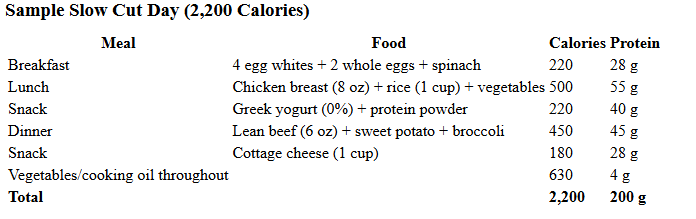
Sample Slow Cut Day (2,200 Calories)
Common Mistakes
Going too aggressive. A 1,000-calorie deficit produces fast weight loss but significant muscle loss. Slow down.
Dropping weight too fast on lifts. Don't preemptively lighten loads. Let performance dictate adjustments.
Excessive cardio. Using cardio to create a 500+ calorie deficit daily is unsustainable and muscle-wasting.
No diet breaks. Extended continuous deficits lead to metabolic adaptation and diet fatigue. Take breaks.
Returning to old eating immediately. After a cut, reverse diet slowly. Jumping back to maintenance causes rapid water and fat regain.
How to Tell It's Working
Weekly indicators: - Weight trending down at target rate (weekly average) - Strength maintained or minimally decreased - Energy manageable (not great, but not debilitating) - Hunger present but not overwhelming
Over 8–12 weeks: - Clear visual changes in body composition - Clothes fitting differently - Strength mostly maintained - No significant injury or illness
Warning signs: - Losing more than 1% bodyweight per week consistently - Strength dropping significantly week over week - Constant hunger, irritability, poor sleep - Getting sick frequently - Losing motivation to train
If warning signs appear, eat at maintenance for 1–2 weeks, then resume with a smaller deficit.
Next Steps
If you want a sustainable cut that preserves your hard-earned muscle:
References
Garthe I, Raastad T, Refsnes PE, Koivisto A, Sundgot-Borgen J. Effect of two different weight-loss rates on body composition and strength and power-related performance in elite athletes. Int J Sport Nutr Exerc Metab. 2011;21(2):97-104. PubMed
Byrne NM, Sainsbury A, King NA, Hills AP, Wood RE. Intermittent energy restriction improves weight loss efficiency in obese men: the MATADOR study. Int J Obes. 2018;42(2):129-138. PubMed
Trexler ET, Smith-Ryan AE, Norton LE. Metabolic adaptation to weight loss: implications for the athlete. J Int Soc Sports Nutr. 2014;11(1):7. PubMed
Helms ER, Aragon AA, Fitschen PJ. Evidence-based recommendations for natural bodybuilding contest preparation: nutrition and supplementation. J Int Soc Sports Nutr. 2014;11:20. PubMed
Murphy CH, Hector AJ, Phillips SM. Considerations for protein intake in managing weight loss in athletes. Eur J Sport Sci. 2015;15(1):21-28. PubMed
This is educational content and not medical advice. Consult a qualified clinician for persistent or severe symptoms.
Protein for Muscle Gain
How Much You Need, Why, and the Easiest Way to Hit It
The Bottom Line
Most lifters need 1.6–2.2 g/kg bodyweight (0.7–1.0 g/lb) for optimal muscle growth
Higher protein during a deficit (2.0–2.4 g/kg) helps preserve muscle
Distribution across 3–5 meals is slightly better than 1–2 meals, but total daily intake matters more
The "anabolic window" is largely a myth to its true impact. just hit your daily target.
If you're not hitting your protein target consistently, nothing else in your nutrition matters much
The Principle
"I eat pretty healthy" is what most people say before discovering they eat only 80 grams of protein per day and wonder why they're not building muscle. It’s time to pick up the fork.
Protein is the only macronutrient that directly provides the building blocks for muscle tissue. You can train perfectly, sleep well, and manage stress, but if protein intake is insufficient, muscle growth will not happen. It’s biology. Your body need materials to create mass on your body.
The good news: the research is clear on how much you need. The bad news: most people consistently undershoot, especially when busy or distracted. The fix isn't complicated, it's consistent.
What the Research Says
There's a clear protein threshold for maximizing muscle growth. Multiple meta-analyses have come upon similar numbers. Morton et al. (2018) found that protein intakes up to ~1.6 g/kg/day (0.73 g/lb) maximized muscle protein synthesis in resistance-trained individuals. Beyond this, additional protein shows diminishing returns.
Higher intakes may help during caloric restriction. Research by Helms et al. (2014) and others suggests that during a caloric deficit, higher protein intakes (up to 2.2–2.6 g/kg/day) may better preserve lean mass.
Protein distribution matters somewhat. Studies show that distributing protein across 3–5 meals produces slightly better muscle protein synthesis than consuming it all in 1–2 meals. However, total daily intake matters more than perfect distribution.
Protein quality matters, but not as much as you think. Animal proteins are generally more bioavailable than plant proteins, but vegans and vegetarians can absolutely build muscle with proper planning and slightly higher total intake.
The "anabolic window" is largely a myth. Research shows that post-workout protein timing is less critical than previously believed, as long as total daily intake is adequate. You don't need to chug a shake within 30 minutes of your last rep.
The Nuance
Body composition affects targets. If you're significantly overweight, basing protein on total bodyweight can lead to unnecessarily high targets. Use lean body mass or target bodyweight instead.
Activity level matters. These recommendations assume regular resistance training. Sedentary individuals need less protein for general health (though still more than the outdated RDA of 0.8 g/kg).
Age affects protein needs. Older adults (50+) may benefit from slightly higher intakes due to reduced anabolic sensitivity (anabolic resistance). Aiming for the higher end of the range makes sense.
More isn't always better. Beyond ~2.2 g/kg/day, additional protein doesn't appear to provide extra muscle-building benefits for most people. It won't hurt, but it won't help much either—and it's expensive.
The Plan
Your Protein Target
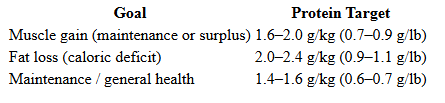
Example calculations:
180 lb lifter, muscle gain: 180 × 0.8 = 144 g protein/day
200 lb lifter, fat loss: 200 × 1.0 = 200 g protein/day
150 lb lifter, maintenance: 150 × 0.7 = 105 g protein/day
If you're significantly overweight, use your target bodyweight or estimate lean mass (total weight minus fat mass).
How to Hit Your Target (Without Obsessing)
Strategy 1: Anchor Protein at Every Meal
Build each meal around a protein source first, then add everything else.
Breakfast: Eggs, Greek yogurt, or protein smoothie, and overnight oats are phenomenal.
Lunch: Chicken, fish, beef, tofu, or legumes
Dinner: Another protein source, similar to lunch
Snacks (if needed): Cottage cheese, jerky, protein bar, or shake
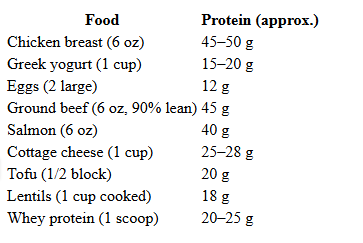
Strategy 2: Know Your High-Leverage Foods
Strategy 3: Use Protein Supplements Strategically
Supplements aren't necessary, but they're convenient. Use them to fill gaps, not replace real food.
Good use cases: - Post-workout when you can't eat a meal - Breakfast on busy mornings (shake takes 2 minutes) - Before bed if you're short on daily target - Travel when food options are limited
Strategy 4: Front-Load Protein Earlier in the Day
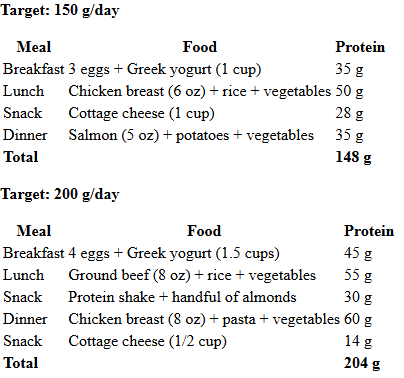
Most people eat low-protein breakfasts and back-load protein at dinner. This often leads to falling short. Aim for 30–50 g at breakfast, and hitting your target becomes much easier.
High-protein breakfast options: - 3–4 eggs + Greek yogurt = 35–40 g - Protein smoothie (whey + Greek yogurt + milk) = 40–50 g - Cottage cheese + eggs = 35–40 g
Strategy 5: Track for One Week, Then Estimate
You don't need to track forever. Track your food for one week to see what your baseline is. Most people discover they're eating 50–70% of what they thought. Once you know your patterns, you can adjust by feel.
Sample Day at Different Protein Targets
Common Mistakes
Relying on "protein is in everything." Yes, bread has some protein. No, it won't help you hit 150 g/day. You need concentrated protein sources.
Skipping breakfast protein. Starting the day with toast and coffee puts you behind. Front-load protein to make the target achievable.
Only counting meat. Greek yogurt, cottage cheese, eggs, and legumes all contribute meaningfully. Diversify your sources.
Assuming you're eating enough. Track for a week. Most people overestimate their protein intake by 30–50%.
Protein paranoia. You don't need to hit your target to the gram every day. Consistency across the week matters more than perfection daily.
How to Tell It's Working
Within 2–4 weeks:
Hunger is more stable (protein is satiating)
Recovery between sessions feels better
Energy is more consistent
Within 8–12 weeks:
Strength is progressing as expected
Muscle fullness and appearance improving
Body composition trending in the right direction
Warning signs you're not eating enough:
Constant hunger on a cut
Strength declining more than expected
Poor recovery, excessive soreness
Muscle loss during dieting (beyond normal)
Next Steps
Related reads: - Protein in a Calorie Deficit: Preserving Muscle While Losing Fat - Slow Deficit Done Right: Lose Fat While Keeping Training Heavy - Whole Foods vs "Clean Eating": How to Eat Like an Adult Without Food Anxiety
If you want nutrition guidance tailored to your goals and lifestyle:
References
Morton RW, Murphy KT, McKellar SR, et al. A systematic review, meta-analysis and meta-regression of the effect of protein supplementation on resistance training-induced gains in muscle mass and strength in healthy adults. Br J Sports Med. 2018;52(6):376-384. PubMed
Helms ER, Zinn C, Rowlands DS, Brown SR. A systematic review of dietary protein during caloric restriction in resistance trained lean athletes: a case for higher intakes. Int J Sport Nutr Exerc Metab. 2014;24(2):127-138. PubMed
Schoenfeld BJ, Aragon AA. How much protein can the body use in a single meal for muscle-building? Implications for daily protein distribution. J Int Soc Sports Nutr. 2018;15:10. PubMed
Stokes T, Hector AJ, Morton RW, McGlory C, Phillips SM. Recent Perspectives Regarding the Role of Dietary Protein for the Promotion of Muscle Hypertrophy with Resistance Exercise Training. Nutrients. 2018;10(2):180. PubMed
Phillips SM, Van Loon LJ. Dietary protein for athletes: from requirements to optimum adaptation. J Sports Sci. 2011;29 Suppl 1:S29-38. PubMed
This is educational content and not medical advice. Consult a qualified clinician for persistent or severe symptoms.
Training Frequency for Muscle Growth: What Matters When Volume Is Equal
The Principle
Training frequency, how many times per week you train a muscle group matters less than most people think. The real driver of muscle growth is total weekly volume (hard sets) and progressive overload. Frequency is just the delivery vehicle.
That said, frequency affects set quality. If you try to cram 16 sets of chest into one session, the last few sets will be significantly worse than the first. Spreading that volume across two sessions usually means better performance on every set.
The debate between "bro splits" and "high frequency" misses the point. The best frequency is the one that lets you accumulate quality volume consistently, fits your schedule, and doesn't leave you too sore or fatigued to perform well.
What the Research Says
Frequency matters less than total volume. A 2016 meta-analysis by Schoenfeld, Ogborn, and Krieger found that training a muscle group twice per week produced significantly more hypertrophy than once per week. However, when total volume was equated, the differences became much smaller.
Twice per week appears to be a practical minimum for most people. The same meta-analysis suggested that hitting each muscle at least twice weekly is likely optimal for hypertrophy in most trainees, primarily because it allows better volume distribution and set quality.
Three times per week may not be better than twice. Research comparing 2× vs 3× per week frequency with equated volume has shown minimal additional benefit from the higher frequency. Some studies suggest potential advantages, but the effects are small.
More frequency allows more volume without excessive fatigue. Studies on high-frequency training (Schoenfeld et al., 2015) have shown that spreading volume across more sessions can allow lifters to tolerate higher total volumes with less accumulated fatigue per session.
Recovery between sessions matters. Research on muscle protein synthesis (MacDougall et al., 1995; Phillips et al., 1997) shows that the anabolic response to training peaks within 24–48 hours and returns to baseline within 48–72 hours. This supports training a muscle again once it's recovered—but "recovered" depends on the individual, the volume, and the intensity.
The Nuance
Schedule trumps optimal. If you can only train 3 days per week, a full-body approach that hits each muscle 3× is theoretically nice, but a 3-day push/pull/legs or upper/lower/full might be more practical and sustainable. The best frequency is the one you'll actually do.
Training age affects tolerance. Beginners can often train a muscle 3× per week with lower volume per session because they don't create as much muscle damage. Advanced lifters may need longer recovery between sessions because their capacity to generate fatigue is higher.
Some muscles recover faster. Biceps, triceps, lateral delts, and calves can often handle higher frequencies (3–4× per week) because they're smaller and recover faster. Large compound movements for quads, back, and chest create more systemic fatigue and may perform better with 2× per week frequency.
Soreness is not a useful guide for most people. DOMS (delayed onset muscle soreness) is a poor indicator of recovery or muscle damage. You can train a muscle while it's still sore, as long as performance isn't significantly impaired.
High frequency works best with lower volume per session. If you train chest 4× per week, each session should have only 3–4 sets. If you train chest 1× per week, you'll need 12–16 sets in that session. The math should add up to your target weekly volume.
The Plan
How to Choose Your Frequency
Step 1: Determine your weekly volume targets
Based on your training level and goals, establish how many sets per muscle group per week you're aiming for. (See the volume landmarks article.)
Step 2: Divide by sessions
Aim for 4–8 hard sets per muscle per session. More than that and set quality tends to decline.
Step 3: Match to your available training days
If you have 4 days to train and want 16 sets of chest per week, that's 8 sets per session across 2 sessions (upper days in an upper/lower split).
Step 4: Adjust based on performance
If your last few sets each session feel significantly weaker than your first few, consider adding frequency to distribute volume better. If you're too sore or fatigued between sessions, consider reducing frequency.
Sample Frequency Setups
4-Day Upper/Lower (Most Versatile): - Train 4 days per week - Each muscle hit 2× per week - 6–10 sets per muscle per session - Good balance of frequency, recovery, and schedule flexibility
3-Day Full Body (Time-Efficient): - Train 3 days per week - Each muscle hit 3× per week - 4–6 sets per muscle per session - Great for beginners or those with limited gym time
6-Day Push/Pull/Legs (High Volume Capacity): - Train 6 days per week - Each muscle hit 2× per week - 6–10 sets per muscle per session - Best for advanced lifters who can recover from high frequency and volume
5-Day Hybrid (Flexible): - Upper / Lower / Push / Pull / Legs - Most muscles hit 1–2× per week; some hit 2× - Allows prioritization of lagging muscle groups - Good for intermediate to advanced lifters
Common Mistakes
Obsessing over frequency instead of volume. Whether you train chest 1×, 2×, or 3× per week matters far less than whether you're accumulating enough hard sets and progressively overloading.
Training too frequently without adjusting volume. If you go from 2× to 4× per week but keep the same sets per session, you've doubled your volume. That's not a frequency change—it's a volume change that will likely exceed recovery.
Ignoring schedule constraints. A 6-day PPL is useless if you can only realistically get to the gym 4 days. Pick a frequency that fits your life.
Using soreness as a recovery indicator. You can train a muscle while sore. Base frequency decisions on performance trends, not feelings.
Overcomplicating the split. For most people, a simple upper/lower or full body split is more effective than elaborate 6-day body part splits. Simplicity aids consistency.
How to Tell It's Working
Within 2–4 weeks:
You're able to complete all planned sets with good form and consistent effort
Weights or reps are progressing across sessions
You don't feel excessively fatigued or sore going into each session
Within 8–12 weeks:
Clear progression in strength or reps across most exercises
Muscle growth (visual or measured)
You've identified a sustainable frequency that matches your recovery and schedule
Warning signs your frequency is wrong:
Consistently poor performance on later sets (frequency too low, sessions too long)
Persistent fatigue or declining performance over weeks (frequency too high, recovery insufficient)
Skipping sessions regularly (schedule mismatch)
Next Steps
Related reads: - How Many Sets Per Muscle Per Week? Volume Landmarks and Recovery Reality - How to Build a 3-Day Strength and Hypertrophy Program - How to Build a 4-Day Program: Upper/Lower vs PPL vs Full Body
If you want a split designed around your schedule and goals:
References
Schoenfeld BJ, Ogborn D, Krieger JW. Effects of Resistance Training Frequency on Measures of Muscle Hypertrophy: A Systematic Review and Meta-Analysis. Sports Med. 2016;46(11):1689-1697. PubMed
Schoenfeld BJ, Ratamess NA, Peterson MD, Contreras B, Tiryaki-Sonmez G. Influence of Resistance Training Frequency on Muscular Adaptations in Well-Trained Men. J Strength Cond Res. 2015;29(7):1821-1829. PubMed
MacDougall JD, Gibala MJ, Tarnopolsky MA, MacDonald JR, Interisano SA, Yarasheski KE. The time course for elevated muscle protein synthesis following heavy resistance exercise. Can J Appl Physiol. 1995;20(4):480-486. PubMed
Phillips SM, Tipton KD, Aarsland A, Wolf SE, Wolfe RR. Mixed muscle protein synthesis and breakdown after resistance exercise in humans. Am J Physiol. 1997;273(1 Pt 1):E99-107. PubMed
Dankel SJ, Mattocks KT, Jessee MB, et al. Frequency: The Overlooked Resistance Training Variable for Inducing Muscle Hypertrophy? Sports Med. 2017;47(5):799-805. PubMed
This is educational content and not medical advice. Consult a qualified clinician for persistent or severe symptoms.
How to Build a 4-Day Program
Upper/Lower vs PPL vs Full Body.. Who Wins?
The Principle
Four training days per week is the sweet spot for most lifters. It's enough frequency to hit each muscle twice per week, enough volume capacity for serious progress, and enough rest days for recovery and life.
But which split? Upper/Lower, Push/Pull/Legs, or Full Body? The answer depends less on which is "optimal" and more on which you'll actually execute consistently. All three can build muscle and strength. The differences are in logistics, preference, and minor efficiency gains.
Here's the reality: the best 4-day split is the one that fits your schedule, lets you train hard without excessive fatigue, and keeps you showing up month after month.
What the Research Says
Training each muscle twice per week is superior to once per week for hypertrophy. The meta-analysis by Schoenfeld et al. (2016) found that 2× per week frequency produced more muscle growth than 1× per week. All three 4-day split options can achieve this.
Total weekly volume matters more than how it's distributed. When volume is equated, different splits produce similar hypertrophy outcomes. The key is accumulating enough hard sets per muscle group per week—not the specific day you do them.
Session duration affects performance. Research on fatigue accumulation shows that set quality declines as sessions get longer. Shorter, more frequent sessions (like an Upper/Lower split) may allow better performance per set compared to fewer, longer sessions.
Recovery needs vary by individual. Studies on training frequency and recovery (Bishop et al., 2008) show significant individual variation. Some lifters thrive on higher frequency; others need more rest between sessions hitting the same muscles.
The Nuance
Upper/Lower is the most versatile 4-day split. It's easy to schedule (any 4 days with at least one rest day between same-type sessions), provides 2× frequency for all muscles, and allows 48–72 hours recovery between sessions for the same muscle groups.
PPL in 4 days is awkward. Push/Pull/Legs is designed for 6 days (each workout twice). In 4 days, you either skip a workout each week (rotating, which gets confusing) or accept that some muscles only get hit 1× per week.
Full Body 4× per week works but requires careful volume management. You can train full body 4 days per week, but each session must have lower volume per muscle to avoid excessive fatigue. This works well for strength-focused training with lower total set counts.
Personal preference matters. Some people hate leg day and prefer it spread across sessions (Upper/Lower). Others love dedicated days for each muscle group (PPL). Neither is wrong if you're consistent.
Common Mistakes
Skipping lower days. Lower body training drives systemic adaptation, hormonal response, and overall strength. Don't skip legs because upper body is more fun.
Making every session a strength day. The hypertrophy-focused sessions exist for a reason. Higher reps with moderate load build muscle and provide variation.
Adding too many exercises. The template has 5–6 exercises per session. That's enough. Adding more leads to junk volume and longer sessions.
Inconsistent scheduling. Pick a schedule and stick to it. The best split is the one you execute consistently.
Ignoring weak points. The template is balanced, but if you have lagging muscle groups, add 1–2 sets of targeted accessory work. Don't just follow the template blindly.
How to Tell It's Working
Within 2–4 weeks:
You've established working weights for all exercises
You're completing sessions in 60–75 minutes
Recovery between sessions feels adequate
Within 8–12 weeks:
Progressive overload is evident (more weight or reps on most exercises)
Visual changes in muscle size or body composition
Strength PRs on primary lifts
You've completed at least one deload and started a new block
Warning signs to adjust:
Consistently failing to recover between sessions (reduce volume or intensity)
Bored or unmotivated (swap exercise variations while keeping movement patterns)
Plateau on multiple lifts for 4+ weeks (reassess nutrition, sleep, or program structure)
Next Steps
Related reads: - How to Build a 3-Day Strength and Hypertrophy Program - How Many Sets Per Muscle Per Week? Volume Landmarks and Recovery Reality - Deloads: When You Need Them, How to Do Them, How to Come Back Stronger
Want a program customized for your goals, schedule, and equipment access?
References
Schoenfeld BJ, Ogborn D, Krieger JW. Effects of Resistance Training Frequency on Measures of Muscle Hypertrophy: A Systematic Review and Meta-Analysis. Sports Med. 2016;46(11):1689-1697. PubMed
Schoenfeld BJ, Ogborn D, Krieger JW. Dose-response relationship between weekly resistance training volume and increases in muscle mass: A systematic review and meta-analysis. J Sports Sci. 2017;35(11):1073-1082. PubMed
Bishop PA, Jones E, Woods AK. Recovery from training: a brief review. J Strength Cond Res. 2008;22(3):1015-1024. PubMed
Grgic J, Schoenfeld BJ, Davies TB, Lazinica B, Krieger JW, Pedisic Z. Effect of Resistance Training Frequency on Gains in Muscular Strength: A Systematic Review and Meta-Analysis. Sports Med. 2018;48(5):1207-1220. PubMed
Ralston GW, Kilgore L, Wyber FB, Baker JS. The Effect of Weekly Set Volume on Strength Gain: A Meta-Analysis. Sports Med. 2017;47(12):2585-2601. PubMed
This is educational content and not medical advice. Consult a qualified clinician for persistent or severe symptoms.
How Many Sets Per Muscle Per Week?
Volume Landmarks and Recovery Reality
What You'll Get From This
— Evidence-based volume ranges for muscle growth, not just arbitrary numbers
— A framework for finding your personal minimum and maximum effective volume
— Practical guidance for adjusting volume based on your life, not just your program
The Bottom Line
— 10–20 sets per muscle per week covers most people, but the range matters
— 10–12 sets = minimum effective for growth; 12–16 = sweet spot; 16–20 = advanced/emphasis phases
— Your maximum recoverable volume depends on sleep, stress, nutrition, and training age
— More is better—until it's not; exceeding your recovery capacity produces diminishing or negative returns
— Volume should fluctuate based on life circumstances, not stay fixed year-round
The Principle
"How many sets should I do?" sounds like a simple question. The answer isn't.
Volume—the total amount of hard work you do for a muscle group—is the primary driver of hypertrophy once you've established sufficient intensity. More volume generally means more growth, up to a point. But that point varies wildly between individuals.
A sleep-deprived parent with a stressful job cannot recover from the same volume as a college student who naps between classes. Your genetics, nutrition, sleep, stress, and training age all determine how much volume you can productively absorb.
The goal is not to do the most volume possible. The goal is to do the most volume you can recover from while still making progress. More is not always better—more is better until it isn't.
What the Research Says
Volume has a dose-response relationship with hypertrophy. A landmark meta-analysis by Schoenfeld et al. (2017) found that higher weekly set volumes produced greater muscle growth, with 10+ sets per muscle group per week outperforming lower volumes. This held true across different training frequencies and rep ranges.
There appears to be an upper limit. While more sets generally help, the returns diminish. Research suggests that beyond ~20 sets per muscle group per week, additional volume provides minimal extra benefit for most lifters and may impair recovery. Some individuals may even see decrements at very high volumes.
Minimum effective dose exists. Studies suggest that even 4–6 hard sets per muscle per week can maintain muscle mass and produce modest growth in trained individuals. This is useful during high-stress periods or recovery phases.
Training status affects optimal volume. Beginners grow from lower volumes; advanced lifters often need higher volumes to continue progressing. A meta-analysis by Rhea et al. (2003) found that trained individuals required more sets than untrained individuals for continued strength gains.
Frequency affects how volume is distributed. Research by Schoenfeld, Ogborn, and Krieger (2016) found that training a muscle twice per week produced more hypertrophy than once per week. However, when total volume was equated, the differences were smaller. The practical takeaway: spread your volume across multiple sessions for better quality sets.
Recovery determines usable volume. Studies on overtraining and overreaching (Kreher & Schwartz, 2012) demonstrate that exceeding recovery capacity leads to performance decrements, mood disturbances, and stalled progress. Volume must be calibrated to recovery, not ambition.
The Nuance
Training age shifts the ranges. Beginners (0–2 years): 8–12 sets/muscle/week is plenty. Intermediates (2–5 years): 12–18 sets often works well. Advanced (5+ years): may need 16–22+ sets for continued growth, carefully periodized.
Not all sets are equal. A set taken 3+ reps from failure contributes less stimulus than a set taken to 1 rep from failure. Volume recommendations assume hard sets—RPE 7–9, not warmups or easy back-off sets.
Different muscles recover at different rates. Smaller muscles (biceps, lateral delts, rear delts) recover faster and can often handle higher frequencies and slightly higher volumes. Large muscles (quads, back) create more systemic fatigue and may require more recovery time between sessions.
Life stress counts as training stress. Your body doesn't distinguish between deadlift fatigue and work deadline fatigue. During high-stress periods, reduce volume. During low-stress periods (vacation, lighter work), you may be able to push volume higher.
Quality beats quantity. Ten high-quality sets with full range of motion, controlled eccentrics, and strong mind-muscle connection will outperform fifteen sloppy sets with rushed form. If you can't maintain execution quality, you've exceeded your useful volume.
The Plan
Volume Landmarks (Per Muscle Group, Per Week):
Maintenance: 4–6 sets — During cuts, high-stress periods, deloads, injury recovery
Minimum Effective: 8–10 sets — Base volume for growth; works for beginners and during recovery phases
Moderate: 12–16 sets — Sweet spot for most intermediate lifters during growth phases
High: 18–22 sets — For advanced lifters or muscle groups that need extra focus
Maximum Recoverable: 22+ sets — Short-term specialization only; requires excellent recovery
How to Find Your Personal Volume Landmarks:
Step 1: Start Conservative. Begin a training block at moderate volume (10–12 sets per major muscle per week). This is your "minimum effective volume" starting point.
Step 2: Add Volume Progressively. Each week, add 1–2 sets per muscle group. Track: Are you still progressing (reps, weight, or quality)? How do you feel (energy, motivation, soreness)? How is sleep and appetite?
Step 3: Identify Your Maximum Recoverable Volume. When you notice progress stalling despite consistent effort, persistent fatigue or excessive soreness, motivation dropping, or sleep/mood worsening—you've likely exceeded your current maximum recoverable volume. Note the set count where performance peaked.
Step 4: Deload and Reset. Take a week at maintenance volume (4–6 sets), then restart your next block slightly below your peak volume, aiming to push past it with better recovery strategies.
Volume Adjustment Based on Life Stress:
Low stress (vacation, good sleep): Push toward high end of your range
Moderate stress (normal life): Stay in your sweet spot
High stress (deadline, travel, poor sleep): Drop to maintenance volume
Extreme stress (illness, crisis, injury): Drop to minimum or take time off
Common Mistakes
Starting at maximum volume. You have nowhere to go when progress stalls. Start lower, build up, and save high volume for when you need it.
Counting junk volume. Warmup sets, half-effort sets, and sets stopped 5+ reps from failure don't count toward productive volume. Be honest about set quality.
Ignoring individual differences. Your training partner might thrive on 20 sets per muscle. You might peak at 14. That's fine. Find your landmarks, not theirs.
Never adjusting for life. Training through a divorce, new baby, or work crisis with the same volume as normal life is a recipe for burnout and injury.
Chasing volume instead of progression. The goal is to do the minimum volume needed to keep progressing, not the maximum you can survive. Save your recovery capacity for when it matters.
How to Tell It's Working
Within 2–4 weeks: You're adding reps or weight to most exercises. Soreness is present but manageable (not debilitating). Energy and motivation remain stable. Sleep and appetite are normal.
Within 8–12 weeks: Visible or measurable muscle growth. Completed a volume progression block successfully. Identified your approximate minimum and maximum volume landmarks. Performance is better than the start of the block.
Warning signs of too much volume: Progress stalls for 2+ weeks despite good sleep and nutrition. Persistent joint aches or unusual soreness patterns. Feeling "flat" in the gym—weights feel heavy, motivation is low. Sleep disruption, appetite changes, mood shifts.
Next Steps
Related reads:
— Progressive Overload That Actually Works: Beyond "Add Weight Every Week"
— Training Frequency for Muscle Growth: What Matters When Volume Is Equal
— Deloads: When You Need Them, How to Do Them, How to Come Back Stronger
If you want a program with volume calibrated to your recovery capacity and life demands:
→ Apply for 1:1 Coaching — depthrx.net/apply
→ Join the Email List — depthrx.net/newsletter
References
1. Schoenfeld BJ, Ogborn D, Krieger JW. Dose-response relationship between weekly resistance training volume and increases in muscle mass: A systematic review and meta-analysis. J Sports Sci. 2017;35(11):1073-1082.
2. Schoenfeld BJ, Ogborn D, Krieger JW. Effects of Resistance Training Frequency on Measures of Muscle Hypertrophy: A Systematic Review and Meta-Analysis. Sports Med. 2016;46(11):1689-1697.
3. Rhea MR, Alvar BA, Burkett LN, Ball SD. A meta-analysis to determine the dose response for strength development. Med Sci Sports Exerc. 2003;35(3):456-464.
4. Kreher JB, Schwartz JB. Overtraining syndrome: a practical guide. Sports Health. 2012;4(2):128-138.
5. Krieger JW. Single vs. multiple sets of resistance exercise for muscle hypertrophy: a meta-analysis. J Strength Cond Res. 2010;24(4):1150-1159.
6. Hackett DA, Johnson NA, Chow CM. Training practices and ergogenic aids used by male bodybuilders. J Strength Cond Res. 2013;27(6):1609-1617.
This is educational content and not medical advice. Consult a qualified clinician for persistent or severe symptoms.
Deload Weeks
When You Need Them, How to Do Them, How to Come Back Stronger
The Bottom Line
Deloads dissipate fatigue while preserving fitness—you often PR after one, not despite one
Signs you need a deload: performance declining 2+ weeks, persistent fatigue, nagging pain, motivation crashing
Signs you don't: one bad session, not feeling like training, you already rested last week
Volume deloads (cut sets in half, keep weight) work for most people most of the time
Schedule deloads proactively every 4–8 weeks rather than waiting until you're forced to
The Principle
"Deloads are for weak people" is what strong people say right before they get injured and take 8 weeks off.
A deload is a planned reduction in training stress that allows accumulated fatigue to dissipate while maintaining your fitness. It's not a break from training—it's a strategic tool that makes the next training block more productive.
Here's the counterintuitive truth: you often get stronger during deloads, not despite them. When you train hard, you build fitness and fatigue simultaneously. Fatigue temporarily masks your fitness. A deload drops the fatigue while preserving the fitness—revealing gains you've already made.
What the Research Says
Fatigue accumulates and masks performance. The fitness-fatigue model (Banister et al., 1975) is well-established in exercise science. Training produces both fitness (which is long-lasting) and fatigue (which is shorter-lasting). During periods of high training stress, fatigue can mask fitness gains. Reducing stress allows fatigue to dissipate faster than fitness.
Planned recovery periods improve long-term performance. Studies on periodization (Issurin, 2010) show that athletes who include planned recovery phases outperform those who train continuously at high intensity. This applies to recreational lifters as well.
Overreaching without recovery leads to overtraining. Research by Meeusen et al. (2013) distinguishes between functional overreaching (short-term fatigue that resolves with rest) and non-functional overreaching (prolonged performance decrements). Deloads prevent the transition from manageable to problematic.
Muscle protein synthesis remains elevated during reduced training. Studies show that muscle maintenance occurs with significantly less volume than muscle building. A deload at reduced volume preserves muscle while allowing systemic recovery.
The Nuance
Not every bad session means you need a deload. A single off day is not overreaching. A bad week during high life stress is not overtraining. Deloads are for accumulated training fatigue, not normal variability.
Deload frequency depends on training intensity and volume. High-volume hypertrophy programs may need deloads every 4–6 weeks. Moderate programs might go 6–8 weeks. Some advanced lifters deload every 3 weeks during peaking phases.
Life stress affects deload timing. If work, family, or other stressors are high, you may need to deload sooner. Your total stress bucket includes everything, not just training.
Deloading is not the same as taking a week off. Complete rest can lead to detraining. A deload maintains the training habit and stimulus while reducing fatigue. You still go to the gym.
The Plan
Signs You Need a Deload
Clear indicators: - Performance has declined for 2+ consecutive weeks despite adequate sleep and nutrition. Persistent fatigue that doesn't resolve with a good night's sleep. Nagging joint pain or excessive soreness. Motivation is significantly lower than usual. Sleep quality has worsened (difficulty falling asleep, waking up frequently)
Subtle indicators: - Weights that should feel moderate feel heavy - Resting heart rate is elevated - Appetite changes (usually decreased) - Irritability, mood swings
Signs You Don't Need a Deload (You're Just Being Soft)
One bad session after a rough night's sleep
Not feeling like going to the gym (but you perform fine once you start)
You took 5 days off last week anyway
You've only been training hard for 2–3 weeks
Deload Protocols
Option 1: Volume Deload (Most Common)
Keep weights the same, cut volume by 40–50%.
If you normally do 4 sets per exercise, do 2
Keep intensity at RPE 6–7
Maintain all movement patterns
Best for: Accumulated volume fatigue, general tiredness
Option 2: Intensity Deload
Keep volume similar, reduce weights by 10–20%.
Same sets and reps
Lighter loads (RPE 5–6)
Focus on technique and speed
Best for: Heavy strength blocks, joint fatigue, neurological fatigue
Option 3: Frequency Deload
Reduce training days, maintain session structure.
If you train 4× per week, train 2–3×
Each session is normal or slightly reduced
Extra rest days for recovery
Best for: High-stress life periods, when you can't get to the gym as often anyway
Option 4: Full Rest Week
No structured training for 5–7 days.
Light activity only (walking, stretching)
Complete physical and mental break
Best for: Severe fatigue, injury recovery, after very intense peaking phases, mental burnout
Sample Volume Deload Week (4-Day Upper/Lower)
Normal Week:
Upper A: 6 exercises, 3–4 sets each = ~22 sets - Lower A: 5 exercises, 3–4 sets each = ~18 sets
Upper B: 6 exercises, 3–4 sets each = ~22 sets - Lower B: 5 exercises, 3–4 sets each = ~18 sets
Deload Week:
Upper A: 6 exercises, 2 sets each = ~12 sets - Lower A: 5 exercises, 2 sets each = ~10 sets
Upper B: 6 exercises, 2 sets each = ~12 sets - Lower B: 5 exercises, 2 sets each = ~10 sets
Intensity stays moderate (RPE 6–7). Weights stay similar to the previous week. You're maintaining the skill of the lifts while cutting fatigue-inducing volume.
Deload Frequency Guidelines
Training Style - High volume hypertrophy (18+ sets/muscle/week), Moderate volume (12–16 sets/muscle/week), Strength-focused (heavy, lower volume)
Deload Frequency - Every 4–5 weeks. Every 6–8 weeks. Every 4–6 weeks, peaking for competitionEvery 3–4 weeks .High life stress period, As needed.
How to Come Back Stronger
The week after a deload is critical. Here's how to maximize it:
Week 1 Post-Deload: - Return to full volume - Weights should feel lighter than before the deload (fatigue has cleared) - Use this window to set rep PRs or test new weights - Don't immediately jump to higher volume than pre-deload
Weeks 2–4 Post-Deload: - Progressive overload resumes - Add small amounts of weight or reps - Build toward the next deload window
Common post-deload mistakes: - Going too hard immediately and re-accumulating fatigue in one week - Testing maxes right after deload (wait 1–2 weeks for neural sharpness) - Skipping the deload benefit by immediately increasing volume
Common Mistakes
Deloading too often. If you deload every 2–3 weeks, you're probably not training hard enough during regular weeks. Build actual fatigue before you dissipate it.
Not deloading often enough. If you go 12+ weeks without a deload, you're likely training in a chronically fatigued state. Planned recovery beats forced recovery.
Using deload week to try new exercises. Keep movements the same. You're recovering, not experimenting.
Training at RPE 9–10 during deload. The point is reduced stress. Crushing yourself with lighter weights defeats the purpose.
Feeling guilty about deloading. Recovery is training. It's not weakness. It's intelligence.
How to Tell It's Working
During the deload week: - Fatigue decreases by mid-week - Sleep quality improves - Motivation starts to return - Joint aches settle down
The week after: - Weights feel lighter than expected - RPE drops for the same loads (225 felt like RPE 8, now feels like RPE 7) - Energy and motivation are high - Ready to push again
If you don't feel better after a deload: - The deload may not have been aggressive enough - Underlying sleep or nutrition issues - Life stress is still high - Consider an additional easy week or full rest
Next Steps
Related reads: - Plateaus: When to Add Volume vs Intensity vs Food vs Sleep - Recovery Basics for Lifters: What Actually Moves the Needle - How Many Sets Per Muscle Per Week? Volume Landmarks and Recovery Reality
If you want intelligent deload timing built into your program:
References
Banister EW, Calvert TW, Savage MV, Bach T. A systems model of training for athletic performance. Aust J Sports Med. 1975;7:57-61.
Issurin VB. New horizons for the methodology and physiology of training periodization. Sports Med. 2010;40(3):189-206. PubMed
Meeusen R, Duclos M, Foster C, et al. Prevention, diagnosis, and treatment of the overtraining syndrome: joint consensus statement. Med Sci Sports Exerc. 2013;45(1):186-205. PubMed
Pritchard H, Keogh J, Barnes M, McGuigan M. Effects and Mechanisms of Tapering in Maximizing Muscular Strength. Strength Cond J. 2015;37(2):72-83. Link
Mujika I, Padilla S. Detraining: loss of training-induced physiological and performance adaptations. Part I: short term insufficient training stimulus. Sports Med. 2000;30(2):79-87. PubMed
This is educational content and not medical advice. Consult a qualified clinician for persistent or severe symptoms.
Hypertrophy vs Strength: What Changes
(and What Doesn’t) in Your Training Plan
What You'll Get From This: (TLDR)
- A clear understanding of why hypertrophy and strength training overlap more than most people think
- The specific variables that actually change when you shift priorities between size and strength
- A framework for programming that lets you build both without chasing two rabbits
The Bottom Line
- Both hypertrophy and strength rely on progressive overload and sufficient volume
- Hypertrophy responds most to total weekly sets taken close to failure
- Strength expression improves most with regular exposure to heavy loads
- Most lifters should bias hypertrophy and layer in heavy work year-round
- You don't need separate "bodybuilding" and "strength" programs to progress
The Principle
Most people think hypertrophy training means light weights and high reps, while strength training means heavy singles and low volume. That belief leads to worse programs, slower progress, and unnecessary plateaus.
The reality is simpler, and more useful: hypertrophy and strength share most of the same training inputs. What changes is emphasis, not identity.
You cannot get significantly stronger without building muscle, and you cannot build significant muscle without getting stronger over time. The relationship is not optional, it’s natural, it's biological. The confusion comes from the fitness industry treating them like opposing camps: "bodybuilding" vs "powerlifting," high reps vs low reps, machines vs barbells.
What changes between a "hypertrophy phase" and a "strength phase" is a few dials, not the entire engine.
—————————————————————————————————————————————————————————————--
What the Research Says
The science on this is clearer than most gym debates suggest.
Muscle growth is driven by mechanical tension. When muscle fibers are placed under load and taken close to failure, they experience mechanical tension that triggers protein synthesis and adaptation. This is true whether you're doing sets of 5 or sets of 15. A 2017 systematic review by Schoenfeld and colleagues found that low-load and high-load training produced similar hypertrophy when volume was equated, as long as sets were taken close to failure. That means WE HAVE TO BE CHALLENGING OURSELVES.
Practical takeaway: Rep range matters less than effort. If you're not close to failure, you're not stimulating much growth.*
Strength, however, is more specific. While bigger muscles have greater force potential, expressing that force, especially under heavy loads, requires neural adaptations and skill practice with heavy weights. A 2016 meta-analysis by Schoenfeld, Wilson, and colleagues showed that while hypertrophy was similar across rep ranges, strength gains were greater with heavier loads (above 60% of 1RM). This aligns with specificity, to get better at lifting heavy, you need to lift heavy.
Practical takeaway: If you want to express strength under maximal loads, you need regular practice with heavy weights, not just muscle.
Volume is the primary driver of hypertrophy. Multiple meta-analyses, including work by Krieger (2010) and Schoenfeld et al. (2017), have established a dose-response relationship between weekly sets per muscle group and muscle growth, at least up to a point. More sets generally means more growth, until recovery becomes the bottleneck.
Practical takeaway: If you want more muscle, your first lever is adding high-quality sets, not chasing new rep schemes or exercises.*
Intensity (load) is the primary driver of strength expression. While you can get stronger across a range of rep ranges, peak strength—your ability to produce maximal force in a single effort—improves most when you regularly practice with loads above 80% of your max.
Frequency matters less than total volume A 2016 meta-analysis by Schoenfeld, Ogborn, and Krieger found that training a muscle group twice per week produced more hypertrophy than once per week, but once weekly volume was equated, the differences shrank. The takeaway: hit your volume targets, and distribute them in a way that allows quality work.
Proximity to failure matters for hypertrophy. Research by Refalo et al. (2021) and others suggests that stopping 3–4 reps from failure may leave growth on the table, while consistently training to absolute failure can increase fatigue without proportional gains. A practical target: most working sets should end 1–3 reps from failure (RPE 7–9).
---
The Nuance
This is where "it depends" actually matters.
Training age changes the equation. Beginners grow from almost anything. Intermediates need more volume and specificity. Advanced lifters often need to periodize more aggressively. Aka dedicated hypertrophy blocks followed by strength peaks, because they can't maximize both simultaneously at high levels.
Recovery capacity varies. A stressed-out parent sleeping five hours a night cannot recover from the same volume as a college student with no responsibilities. If you're in a demanding life phase, prioritize intensity (strength) over volume (hypertrophy)—you'll maintain muscle with less systemic fatigue.
Injury history matters. If certain movements cause pain, hypertrophy training gives you more flexibility. You can load a muscle through many different exercises and angles. Strength training requires more specificity, if your goal is a bigger squat, you need to squat. Pain-aware lifters often do well with hypertrophy-focused phases that build tissue capacity before returning to heavy strength work.
Goals dictate emphasis, not method. If you want to compete in powerlifting, you need dedicated strength phases with heavy singles, doubles, and triples. If you want to look better and feel strong, a hypertrophy-biased approach with occasional heavy work is more sustainable. Most lifters are training for life, not a platform. For them, hypertrophy with strength maintenance is usually the right call.
---
Which Should You Bias Right Now?
Bias hypertrophy if:
- You're stalling on adding load to the bar
- You're chronically beat up or managing nagging issues
- Life stress is high and recovery is compromised
- You want to look better and feel more muscular
Bias strength if:
- You compete or test maxes regularly
- You already have muscle but lack force expression
- You're sleeping and eating well with low life stress
- You want to feel more confident under heavy loads
The Plan
Here's how to structure your training depending on your current priority.
If Hypertrophy Is Your Priority
Rep range: Mostly 6–12 reps, with some work in the 12–20 range for smaller muscles and isolation movements
Intensity: RPE 7–9 (1–3 reps from failure on most sets)
Volume: 10–20 sets per muscle group per week, distributed across 2–3 sessions
- 10–12 sets = minimum effective dose
- 12–16 sets = sweet spot for most lifters
- 16–20 sets = advanced or short-term emphasis phases
- Exercise selection: Prioritize exercises that challenge the muscle through a full range of motion with a strong stretch and contraction; machines and cables are valuable here
- Progression: Add reps before adding weight; when you hit the top of your rep range for all sets, increase load
- Heavy work: Include 1–2 compound lifts per session in the 4–6 rep range to maintain strength
If Strength Is Your Priority
Strength work should feel heavy, but heavy doesn't mean sloppy or maximal every session. It means deliberate exposure to loads that challenge your force production.
- Rep range: Mostly 1–5 reps on main lifts, with supplemental work in the 6–10 range
- Intensity: RPE 8–10 on main lifts; accessories can stay at RPE 7–8
- Volume: Lower than hypertrophy phases (8–12 sets per muscle group per week); quality over quantity
- Exercise selection: Prioritize the lifts you want to get stronger at; specificity matters more here
-Progression: Add weight when you hit your rep target; use percentage-based or RPE-based progression
- Hypertrophy work: Include 2–4 accessory movements per session in moderate rep ranges to maintain muscle mass and address weak points
Sample Weekly Structure (Intermediate Lifter)
Hypertrophy Emphasis (4 days):
| Day | Focus | Rep Ranges |
| Monday | Lower (quad focus) | 6–12 main lifts, 10–15 accessories |
| Tuesday | Upper (push focus) | 6–12 main lifts, 10–15 accessories |
| Thursday | Lower (hip focus) | 6–12 main lifts, 10–15 accessories |
| Friday | Upper (pull focus) | 6–12 main lifts, 10–15 accessories |
Strength Emphasis (4 days):
| Day | Focus | Rep Ranges |
| Monday | Squat + quad accessories | 3–5 main lift, 6–10 accessories |
| Tuesday | Bench + push accessories | 3–5 main lift, 6–10 accessories |
| Thursday | Deadlift + hip accessories | 3–5 main lift, 6–10 accessories |
| Friday | Press + pull accessories | 3–5 main lift, 6–10 accessories |
Common Mistakes
- Thinking you have to choose one forever. You can alternate emphasis every 8–16 weeks. Most lifters benefit from spending more time in hypertrophy phases and peaking strength occasionally.
- Going too light on hypertrophy work. If you're not within 3 reps of failure, you're not stimulating much growth. Pump and burn are not reliable indicators—proximity to failure is.
- Going too heavy too often on strength work. Grinding reps at RPE 10 every session is a fast track to burnout and injury. Most strength work should be RPE 8–9.
- Neglecting the other quality. Pure hypertrophy with no heavy work leads to "fluffy" strength. Pure strength with no volume leads to stagnation when your muscle mass can't support further gains.
- Copying elite programs. A professional bodybuilder's volume or a world-class powerlifter's intensity are calibrated for their genetics, recovery resources, and drug support. Train for your life, not theirs.
How to Tell It's Working
Within 2–4 weeks:
- Hypertrophy focus: You should be adding reps or small amounts of weight to most exercises. Muscles should feel "fuller" after sessions, and you may notice improved mind-muscle connection.
- Strength focus: Your top sets should feel more confident and controlled. RPE on working weights should drop (same weight feels easier), or you should be hitting rep PRs.
Within 8–12 weeks:
- Hypertrophy focus: Visual changes in muscle size, improved pump during sessions, measurable increases in training volume (more sets, reps, or load over time).
- Strength focus: PR attempts should succeed more often. Your ability to express force under maximal loads should improve even if muscle size hasn't changed dramatically.
If you're not seeing these signals, the most common issues are: insufficient proximity to failure (hypertrophy), insufficient heavy practice (strength), inadequate recovery (both), or stagnant loads with no progression plan (both).
---
Next Steps
**Related reads:**
- Progressive Overload That Actually Works: Beyond "Add Weight Every Week"
- How Many Sets Per Muscle Per Week? Volume Landmarks and Recovery Reality
- RPE and RIR Explained for Lifters Who Train Heavy
**If you want a program that balances hypertrophy, strength, and joint longevity for your schedule:**
[→ Apply for 1:1 Coaching](https://depthrx.net/apply)
**If you want weekly training insights without the noise:**
[→ Join the Email List](https://depthrx.net/newsletter)
---
References
1. Schoenfeld BJ, Grgic J, Ogborn D, Krieger JW. Strength and Hypertrophy Adaptations Between Low- vs. High-Load Resistance Training: A Systematic Review and Meta-analysis. *J Strength Cond Res.* 2017;31(12):3508-3523. [PubMed](https://pubmed.ncbi.nlm.nih.gov/28834797/)
2. Schoenfeld BJ, Wilson JM, Lowery RP, Krieger JW. Muscular adaptations in low- versus high-load resistance training: A meta-analysis. *Eur J Sport Sci.* 2016;16(1):1-10. [PubMed](https://pubmed.ncbi.nlm.nih.gov/25530577/)
3. Krieger JW. Single vs. multiple sets of resistance exercise for muscle hypertrophy: a meta-analysis. *J Strength Cond Res.* 2010;24(4):1150-1159. [PubMed](https://pubmed.ncbi.nlm.nih.gov/20300012/)
4. Schoenfeld BJ, Ogborn D, Krieger JW. Dose-response relationship between weekly resistance training volume and increases in muscle mass: A systematic review and meta-analysis. *J Sports Sci.* 2017;35(11):1073-1082. [PubMed](https://pubmed.ncbi.nlm.nih.gov/27433992/)
5. Schoenfeld BJ, Ogborn D, Krieger JW. Effects of Resistance Training Frequency on Measures of Muscle Hypertrophy: A Systematic Review and Meta-Analysis. *Sports Med.* 2016;46(11):1689-1697. [PubMed](https://pubmed.ncbi.nlm.nih.gov/27102172/)
6. Refalo MC, Helms ER, Trexler ET, Hamilton DL, Fyfe JJ. Influence of Resistance Training Proximity-to-Failure on Skeletal Muscle Hypertrophy: A Systematic Review with Meta-analysis. *Sports Med.* 2022;52(5):1079-1104. [PubMed](https://pubmed.ncbi.nlm.nih.gov/35044672/)
7. Grgic J, Schoenfeld BJ, Skrepnik M, Davies TB, Mikulic P. Effects of Rest Interval Duration in Resistance Training on Measures of Muscular Strength: A Systematic Review. *Sports Med.* 2018;48(1):137-151. [PubMed](https://pubmed.ncbi.nlm.nih.gov/28933024/)
---
*This is educational content and not medical advice. Consult a qualified clinician for persistent or severe symptoms.*

Redefine Success
It All Begins Here
Confidence doesn’t always arrive with a bold entrance. Sometimes, it builds quietly, step by step, as we show up for ourselves day after day. It grows when we choose to try, even when we’re unsure of the outcome. Every time you take action despite self-doubt, you reinforce the belief that you’re capable. Confidence isn’t about having all the answers — it’s about trusting that you can figure it out along the way.
The key to making things happen isn’t waiting for the perfect moment; it’s starting with what you have, where you are. Big goals can feel overwhelming when viewed all at once, but momentum builds through small, consistent action. Whether you’re working toward a personal milestone or a professional dream, progress comes from showing up — not perfectly, but persistently. Action creates clarity, and over time, those steps forward add up to something real.
You don’t need to be fearless to reach your goals, you just need to be willing. Willing to try, willing to learn, and willing to believe that you’re capable of more than you know. The road may not always be smooth, but growth rarely is. What matters most is that you keep going, keep learning, and keep believing in the version of yourself you’re becoming.

Small Steps Create Big Shifts
It All Begins Here
Confidence doesn’t always arrive with a bold entrance. Sometimes, it builds quietly, step by step, as we show up for ourselves day after day. It grows when we choose to try, even when we’re unsure of the outcome. Every time you take action despite self-doubt, you reinforce the belief that you’re capable. Confidence isn’t about having all the answers — it’s about trusting that you can figure it out along the way.
The key to making things happen isn’t waiting for the perfect moment; it’s starting with what you have, where you are. Big goals can feel overwhelming when viewed all at once, but momentum builds through small, consistent action. Whether you’re working toward a personal milestone or a professional dream, progress comes from showing up — not perfectly, but persistently. Action creates clarity, and over time, those steps forward add up to something real.
You don’t need to be fearless to reach your goals, you just need to be willing. Willing to try, willing to learn, and willing to believe that you’re capable of more than you know. The road may not always be smooth, but growth rarely is. What matters most is that you keep going, keep learning, and keep believing in the version of yourself you’re becoming.

Turn Intention Into Action
It All Begins Here
Confidence doesn’t always arrive with a bold entrance. Sometimes, it builds quietly, step by step, as we show up for ourselves day after day. It grows when we choose to try, even when we’re unsure of the outcome. Every time you take action despite self-doubt, you reinforce the belief that you’re capable. Confidence isn’t about having all the answers — it’s about trusting that you can figure it out along the way.
The key to making things happen isn’t waiting for the perfect moment; it’s starting with what you have, where you are. Big goals can feel overwhelming when viewed all at once, but momentum builds through small, consistent action. Whether you’re working toward a personal milestone or a professional dream, progress comes from showing up — not perfectly, but persistently. Action creates clarity, and over time, those steps forward add up to something real.
You don’t need to be fearless to reach your goals, you just need to be willing. Willing to try, willing to learn, and willing to believe that you’re capable of more than you know. The road may not always be smooth, but growth rarely is. What matters most is that you keep going, keep learning, and keep believing in the version of yourself you’re becoming.

Make Room for Growth
It All Begins Here
Confidence doesn’t always arrive with a bold entrance. Sometimes, it builds quietly, step by step, as we show up for ourselves day after day. It grows when we choose to try, even when we’re unsure of the outcome. Every time you take action despite self-doubt, you reinforce the belief that you’re capable. Confidence isn’t about having all the answers — it’s about trusting that you can figure it out along the way.
The key to making things happen isn’t waiting for the perfect moment; it’s starting with what you have, where you are. Big goals can feel overwhelming when viewed all at once, but momentum builds through small, consistent action. Whether you’re working toward a personal milestone or a professional dream, progress comes from showing up — not perfectly, but persistently. Action creates clarity, and over time, those steps forward add up to something real.
You don’t need to be fearless to reach your goals, you just need to be willing. Willing to try, willing to learn, and willing to believe that you’re capable of more than you know. The road may not always be smooth, but growth rarely is. What matters most is that you keep going, keep learning, and keep believing in the version of yourself you’re becoming.